Tooth Abscess In Children In 2026: Save The Baby Tooth Or Pull It?
Written By: Logan Grover, Content Writer |
Reviewed By: Dr. Alison Grover, Board-Certified Diplomate Pediatric Dentist |
Last Reviewed: October 2, 2026 |
A tooth abscess in children needs a dentist the same day you spot it. It won't heal on its own, and antibiotics alone won't clear it. The fix is to treat the tooth: clean out the infected nerve with a pulpectomy and cover the tooth with a crown, or take the tooth out.
Go to the ER first if your child has trouble breathing or swallowing, or swelling that spreads toward the eye or down the neck. For anything less, call your dentist today. After hours, current Mini Miners patients can call (303) 500-3202 and press 2 to reach our on-call dentist.
A tooth abscess in children is a pocket of pus that forms when bacteria reach the nerve inside a tooth, usually through a deep cavity or a cracked tooth. In baby teeth, it often shows up as a pimple-like bump on the gum. It won't go away alone, and only treating the tooth clears it.
"It's a baby tooth, so pull it" sounds reasonable, and sometimes it's the right call. But a baby molar stays in until age 9 to 12 on the American Dental Association's (ADA) tooth chart. An infection sitting on top of the adult tooth for that long can leave marks on it.

Is a Tooth Abscess in Children an Emergency?
Yes. Unless your child shows the red flags in the first row below, the place to go is the dentist's chair. The ER comes first only when the infection is spreading fast enough to affect breathing, swallowing, or the eye.
The American Academy of Pediatric Dentistry (AAPD) draws the line at swelling that keeps spreading along with signs of illness, "eg, fever, difficulty breathing or swallowing." For those children, its antibiotic guideline says treating the infection right away, along with IV antibiotics, brings a faster cure. Start at the ER.
What you see | Where to go | How fast |
Trouble breathing or swallowing, drooling, swelling that spreads down the neck or toward the eye, or a swollen face with a fever in a child who seems sick | Hospital emergency room | Now |
A swollen cheek or gum, or pain that keeps your child up at night | Dentist. After hours, current Mini Miners patients: (303) 500-3202, press 2 | Today |
A painless bump on the gum, or a front tooth turning gray | Dentist | Today. Established patients can get a same-day emergency appointment |
The ER treats the spread. A dentist still has to treat the tooth, so plan on a dental visit right after. Our toothache emergency guide covers the other ER-or-dentist calls, from knocked-out teeth to chipped ones.

Where a Child's Abscess Starts
Usually, an abscess in a child starts as a cavity nobody treated. Decay works through the enamel, then the softer dentin, then reaches the nerve. Bacteria infect the nerve, the nerve dies, and pus collects at the tip of the root.
That takes time, which is good news for parents. A 2017 study in the Journal of Clinical Pediatric Dentistry tracked baby-tooth cavities on X-rays in 95 children aged 5 to 12. Decay took about 0.8 years to get through the outer enamel and about 1.4 more years to reach the inner dentin. The kids came from 1 clinic in Jerusalem, so treat those numbers as a rough guide.
Not every cavity gets caught. In the CDC's 2024 oral health surveillance report, 11% of children aged 2 to 5 and 18% of children aged 6 to 8 had untreated decay in their baby teeth (survey years 2017 to March 2020).
Injuries cause others. A hard knock can injure the nerve inside a front tooth even when the tooth looks fine. Weeks or months later, the tooth may turn gray, and an abscess can follow. Learning the early signs of decay gives you the best shot at stopping a cavity before it gets this far.
What Does an Abscessed Tooth Look Like in a Child?
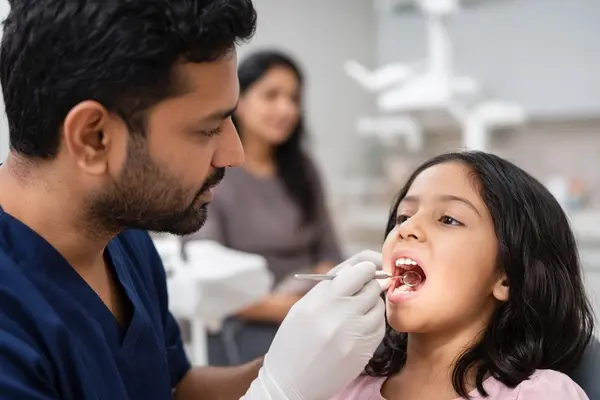
A classic sign in a baby tooth is a small, pimple-like bump on the gum near the root of the bad tooth. Dentists call it a sinus tract or gum boil. It's the abscess draining through the gum.
Other signs:
Swelling of the gum, the cheek, or under the jaw
Pain when chewing, or when you tap the tooth
A tooth that's loose before its time, or turning gray or dark
A bad taste or bad breath that brushing doesn't fix
A fever, or a child who's tired and off their food
Watch out for pain that stops on its own. When the nerve dies, it can't send pain signals anymore. When the gum bump drains, the pressure drops and the ache eases. Both feel like healing to a child. The infection at the root tip keeps going.
An X-ray confirms it. The infection shows up as a dark area around the root tip, and the same picture shows how close it sits to the adult tooth forming underneath.

Why Antibiotics Alone Won't Fix It
Antibiotics can't cure a tooth abscess by themselves. If your child has no fever and no facial swelling, the AAPD says they aren't even called for.
The 2026 guideline puts it plainly: "Antibiotic therapy is not indicated nor effective if the dental infection is contained within the pulpal tissue or the immediate surrounding tissue." A dead nerve has no blood flow, so medicine in the bloodstream can't reach the bacteria inside the tooth. An abscess treated with pills alone tends to flare up again after the last dose.
Antibiotics carry a cost, too. The AAPD notes that up to 15% of community-acquired C. diff infections, a gut infection that causes severe diarrhea, have been traced to antibiotics prescribed for dental procedures.
They do have a job when the infection is spreading: a swollen face, a fever, a child who seems sick. Even then, the AAPD calls antibiotics "an adjunct to, not an alternative for" treating the tooth. Sometimes the swelling has to come down before the tooth can be treated safely, so the antibiotic comes first.
Should an Abscessed Baby Tooth Be Saved or Pulled?
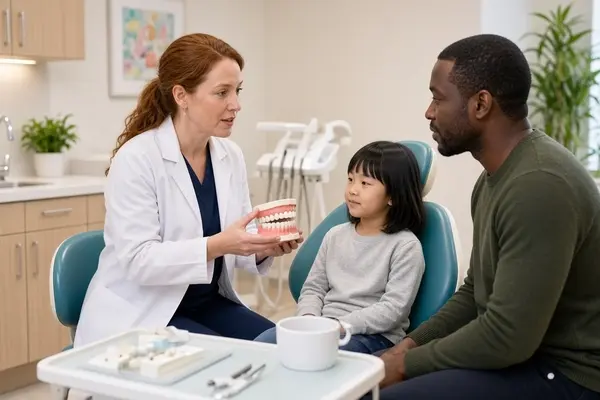
Save it when the roots are still sound and the adult tooth is years away. Pull it when the infection has destroyed too much tooth or root, or when the adult tooth is close to coming in.
The AAPD's 2026 pulp therapy guideline sets the criteria. A pulpectomy, the baby-tooth version of a root canal, fits a tooth with a dead or badly inflamed nerve, as long as the roots show "minimal or no resorption." Extraction makes sense when the infection can't be stopped, the bone support can't be regained, or too little tooth is left to restore.
You'll see pulpectomy and pulpotomy mixed up online. A pulpotomy removes only the top part of the nerve, and the AAPD limits it to teeth with "no radiographic signs of infection." It isn't the fix for an abscess.
Option | What it does | When it fits | What comes next |
Pulpectomy | Removes the infected nerve from the crown and the roots, then fills the canals | Dead or infected nerve, roots mostly intact, adult tooth still years away | A crown to protect the tooth |
Extraction | Takes the tooth out | Infection can't be controlled, bone support is lost, too little tooth is left, or the adult tooth is close | A space maintainer if the gap needs holding |
Pulpotomy | Removes only the top of the nerve | Nerve exposed by decay but not infected | Not used for an abscess |
Antibiotics only | Pills | Not a treatment on its own, per the AAPD | The tooth still needs one of the options above |
Age changes the math. On the ADA's tooth chart, baby first molars fall out at 9 to 11 and second molars at 10 to 12. An abscessed molar in a 4-year-old has 5 to 8 more years of chewing to do. A loose molar in an 11-year-old may be close to falling out by itself.
Mini Miners offers both paths as part of our restoration care in Erie: pulp therapy to save a baby tooth, and space maintainers to hold the gap after one comes out.

Can an Abscessed Baby Tooth Damage the Permanent Tooth?
Yes. The adult tooth forms in a small sac right under the baby tooth's roots, and an abscess sits on top of it.
A 2023 study in Cureus compared 256 infected baby molars with 245 healthy molars on the other side of the same mouths, using panoramic X-rays of children aged 4 to 10. Under the infected molars, 34% of the adult teeth showed damage to the sac around them. Another 25.8% were off their normal eruption path, and 6.6% were misshapen. Development of those adult teeth ran 4 to 6 months behind. The authors note a limit: panoramic X-rays are flat 2D pictures.
So "it'll fall out anyway" doesn't hold up. Waiting gives the infection more time on top of the adult tooth.
Pulling a baby molar years early has its own cost. The teeth beside the gap can drift into it. In its guideline on the developing dentition, the AAPD says space maintainers "should be considered" after baby teeth are lost early, to lower the odds of crowding and bite problems. If your child's baby tooth extraction calls for one, we'll tell you before you leave.

What Abscess Treatment Looks Like at Mini Miners
You stay in the room and help make the save-or-pull call. At Mini Miners Pediatric Dentistry, parents are always welcome in the treatment room and are part of every treatment decision. We take X-rays right in that room with a camera-like unit, so your child keeps watching their movie.
Numbing works less well in infected, swollen tissue. Your child may get laughing gas to relax before we numb the area, and our sedation options come in 3 levels:
Nitrous oxide (laughing gas). Every treatment room is plumbed for it, so it's ready right away.
Moderate sedation: 2 medicines, Versed and hydroxyzine, in liquid form.
General anesthesia, given in our office by an anesthesiologist through gas and an IV. We work with Mile High Anesthesia and Rocky Mountain Dental Anesthesia.
Parents step out for only 1 thing, general anesthesia: once your child is asleep, you'll wait in the waiting room, and we bring you into recovery before your child wakes up. Kids won't hear the words shot, pain, or hurt here. Our chairs can also be positioned for a child who gets anxious lying back.
A baby molar that has had its nerve treated usually needs a crown, because the hollowed-out tooth breaks more easily. On back molars, we offer white crowns made from ceramic or zirconia, along with traditional stainless steel.
We give you a cost estimate before treatment starts, and we offer in-office payment plans and take CareCredit and HSA/FSA cards. The Mini Miners Membership Plan costs $300 a year for toddlers from first tooth to age 3 and $420 a year for kids 4 and up. Both plans include 1 emergency exam a year and up to 20% off other treatments (some exclusions apply).
What to Do Tonight Before the Dentist
Control the pain and leave the gum bump alone until the dentist sees the tooth.
Give acetaminophen or ibuprofen, dosed by your child's weight. The ADA's 2023 pain guideline names them first-line for dental pain in kids under 12. Ask your pediatrician if you're unsure of the dose.
Skip codeine and tramadol. The FDA ruled them out for children under 12 in 2017.
Hold a cold pack wrapped in a cloth on the outside of the cheek for 10 to 15 minutes at a time.
Don't put heat on the face, and don't squeeze or pop the gum bump.
Don't use leftover antibiotics from a sibling or an old prescription.
Offer soft, cool food and plenty of water.
Pain medicine buys time. It doesn't treat the infection.

How to Prevent the Next Abscess in 2026
Catch the cavity while it's small. The AAPD recommends a checkup every 6 months, adjusted for your child's cavity risk.
That schedule lines up with the 2017 study above. Decay took about 0.8 years (roughly 10 months) to cross baby-tooth enamel, so 6-month visits give the dentist at least 1 look while it's still shallow and still a small fix. The Mini Miners membership plan includes 2 cleanings and 2 exams a year, which covers that schedule.
Call About a Swollen Face or Gum Bump in Erie
Call (303) 500-3202 during office hours, Monday to Thursday 8 to 5 and Friday 8 to 3:30, and tell the front desk it's an emergency. After hours, current patients can press 2 to reach our on-call dentist. Established patients can get same-day emergency dental visits. We're at 61 Erie Pkwy, Unit 101, in Erie Commons. Treat a tooth abscess in children as a same-day call, even if the pain has stopped.
Tooth Abscess in Children FAQ
Can a tooth abscess in children go away on its own?
No. The pain can stop when the nerve dies or the gum bump drains, but the infection stays at the root tip. In a 2023 study of 256 infected baby molars, 34% of the adult teeth underneath showed damage to the sac around them, so waiting has a cost even when your child seems fine.
Will antibiotics cure a tooth abscess in children?
No. The AAPD's 2026 guideline says antibiotic therapy is "not indicated nor effective" when the infection is contained in and around the tooth. It calls antibiotics "an adjunct to, not an alternative for" treating the tooth, so for an abscess, they're for an infection that's spreading.
What can I give my child for abscess pain?
Acetaminophen or ibuprofen, dosed by weight. The ADA's 2023 guideline names them first-line for dental pain in children under 12, and the FDA ruled out codeine and tramadol for that age group in 2017. Pain medicine doesn't treat the infection, so call the dentist the same day.
Is a pimple on my child's gum an abscess?
It's a common sign of one. A bump on the gum near a baby tooth is often an abscess draining through the gum, even when it doesn't hurt. An X-ray confirms it, showing the infection as a dark area at the root tip.
Does an abscessed baby tooth have to be pulled?
Not always. If the roots are still mostly intact, a pulpectomy can save the tooth, and the AAPD sets "minimal or no resorption" of the roots as the bar. Baby molars stay in until age 9 to 12 on the ADA's tooth chart, so saving one is often worth it for a young child.
Does my child need sedation to treat an abscessed tooth?
It depends on your child and the tooth. Mini Miners offers 3 levels: nitrous oxide in every room, moderate oral sedation, and general anesthesia given in the office by an anesthesiologist. Infected tissue numbs less well, so we go over the options with you before treatment starts.


Comments