Child Chipped Tooth: What To Do First
Written By: Logan Grover, Content Writer |
Reviewed By: Dr. Alison Grover, Board-Certified Diplomate Pediatric Dentist |
Last Reviewed: September 30, 2026 |
When your child chips a tooth, do 4 things. Rinse the mouth with warm water. Hold a cold compress against the outside of the cheek. Find the broken piece, and keep it wet in water or saline. Then call us at 303-500-3202. If you're already a patient and it's after hours, press 2 and you'll reach the pediatric dentist on call.
The chip you can see tells me almost nothing. I've smoothed edges that made parents gasp and sent the kid home in one short visit. I've also found a fracture below the gumline under a chip a mom described as tiny. Since I opened Mini Miners Pediatric Dentistry in Erie in 2017, that pattern hasn't changed. What sits under the chip is what decides the treatment.

What Is a Chipped Tooth in a Child?
A chipped tooth in a child is a fracture of the crown, the part of the tooth above the gum. Dentists sort it by depth: enamel only, enamel plus dentin, or deep enough to expose the pulp, where the nerve and blood supply sit. Depth, not size, decides the treatment and the urgency.
This happens a lot. Worldwide, about 22.7% of children have a traumatic injury to a primary tooth, according to the NIH's StatPearls review of trauma to the primary dentition. In preschoolers, oral injuries make up 17% of all physical injuries, against 5% across all ages. Toddlers take the brunt of it, for the obvious reason that they are learning to run before they've learned to fall.
Do These 5 Things in the First 10 Minutes
Work in this order, and don't skip step 1. Each step below stands on its own.
Rule out the bigger injury first. Trouble breathing, vomiting, confusion, a blow to the head, or bleeding that won't slow after 10 minutes of steady pressure means the emergency room comes first and the tooth comes second.
Rinse with warm water, not cold. Cold water on freshly exposed dentin stings. Warm water clears the grit so you can see the tooth.
Hold a cold compress outside the cheek, 10 minutes on and 10 off. This is for the lip and gum swelling, which is usually the part that looks alarming and matters least.
Find the piece and keep it wet in water or saline. The 2020 International Association of Dental Traumatology guideline is specific: a fragment that has dried out gets soaked in water or saline for 20 minutes before we bond it back. You may have read about using milk. Milk is the correct medium for a whole tooth that's been knocked out, because it protects the living ligament cells on the root. A chip of enamel has no such cells. It only needs to stay hydrated.
Call, and use the word "chipped." It changes how we schedule you. A chipped tooth with a pink dot goes in the same-day slot; a rough white edge does not need to. Our emergency dental visits for kids run out of the same Erie Pkwy office, so you're not being sent across town.
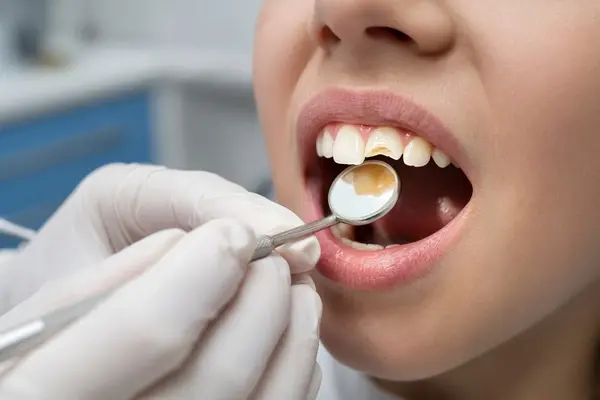
How Deep Is the Chip? Three Levels You Can See From Your Kitchen
You can classify this yourself in about 30 seconds, in decent light, with your phone flashlight.
What you see | What it is | How fast we need to see it | What we usually do |
Rough white or clear edge, no color change, no pain | Enamel only | Within a week | Smooth the edge, or bond a small amount of composite if it shows |
A yellow or tan patch inside the white | Enamel and dentin | Same day or next day | Seal the exposed dentin, then rebuild the shape |
A pink or red dot, bleeding from the tooth itself, sharp pain from air or cold water | Pulp exposed | Same day | Partial pulpotomy to keep the tooth alive, then rebuild |
Dentin is the yellow layer under enamel, and it's full of microscopic tubes that run straight to the nerve. That's why a dentin-level chip aches in cold air and an enamel-level chip doesn't. IADT calls for sealing that dentin, with glass ionomer or bonded composite, precisely to shut those tubes off from bacteria.
If the pulp is exposed, the guideline points to a partial pulpotomy, using non-setting calcium hydroxide or a non-staining calcium silicate cement, rather than pulling the tooth or jumping to a root canal.
Is a Chipped Tooth a Dental Emergency?
It depends on the depth. A chip that exposes the nerve is a same-day problem. A rough enamel edge is not, and I'd rather you sleep and call in the morning than sit in an emergency room at 11 p.m.
Sign | Where it goes |
Pink or red dot, or bleeding from the tooth itself | Same day |
Tooth is loose, moved, or pushed up into the gum | Same day |
Sharp pain from cold air or water | Same day |
Yellow patch showing, no pain | Within 24 to 48 hours |
Rough white edge, no pain, no color change | Within a week |
Lip or gum cut still bleeding after 10 minutes of pressure | Emergency room |
We keep same-day slots for our patients of record, and emergencies get first claim on them. If you want the wider version of this triage, our guide to what Erie parents should do first covers knocked-out teeth, swelling, and bleeding too.

Baby Tooth or Adult Tooth Changes the Whole Plan
Same chip, two different problems. IADT publishes separate guidelines for primary and permanent teeth, and the follow-up schedules differ.
With a permanent tooth, we're protecting a tooth your child keeps for life, so keeping the nerve alive drives everything. With a baby tooth, we weigh the chip against how long that tooth was staying anyway. A chipped upper front baby tooth at age 3 has roughly 3 to 4 years left on the clock. At age 6 it may be loose already. Our guide to when baby teeth fall out will tell you where your child sits.
That does not mean a chipped baby tooth gets ignored. Exposed dentin still lets bacteria in, and a young child who won't chew on that side stops eating properly.
Can a Chipped Baby Tooth Damage the Adult Tooth Underneath?
A chip alone rarely does. The IADT primary dentition guideline names intrusion and avulsion, meaning the tooth being driven up into the bone or knocked clean out, as the injuries most often linked to anomalies in the permanent teeth: discoloration, enamel defects, bent roots, and eruption problems.
Two things in that guideline surprise most parents. An avulsed baby tooth is never replanted, and the main reason is the risk of the child aspirating it. An immediate extraction of an intruded baby tooth is no longer advised, because intruded primary teeth often re-erupt on their own, extraction can damage the tooth bud, and there's no evidence that pulling it early protects anything.
So when I take an x-ray after a chip, I'm not looking at the chip. I'm looking for displacement.
How Long Do You Really Have to Save the Nerve?
Longer than you've been told. You'll find pages saying you have 24 hours to save an exposed nerve. The evidence doesn't support that number.
A 2022 systematic review in the International Endodontic Journal reviewed 7 clinical studies of pulpotomy after crown fractures that exposed the pulp. Success ran from 75% to 96%. Five of those studies specifically tested whether the delay between injury and treatment changed the outcome, and the review's finding was that there was no significant impact in any of them. One study put pulpotomy at 90.9% against 67% for pulp capping, which points at the real variable: whether the contaminated surface layer of pulp gets removed, not how fast you got to the chair.
I'm not telling you to wait. Come in today. Bacteria have a head start the moment the pulp is open, and the x-ray finding is the reason to hurry regardless. But if you're reading this on day 4 and blaming yourself, stop. That tooth is very likely still savable.
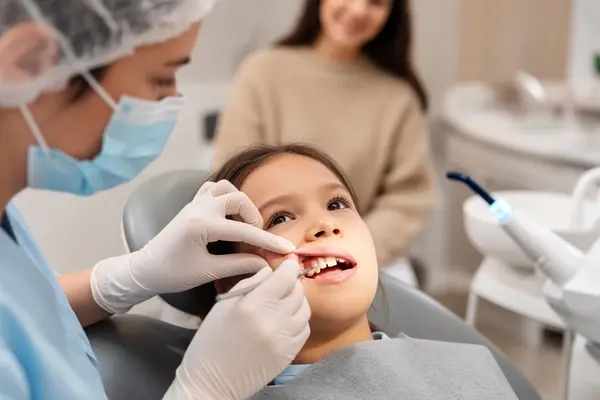
How We Repair a Chipped Tooth at Our Erie Office in 2026
The repair is the easy half. Getting a usable x-ray on a scared 4-year-old who just hurt herself is the hard half, and it's where most of these appointments fall apart.
Our x-ray unit is a camera-style head we bring into the treatment room, so your child stays in the chair watching one of 70-plus movies instead of standing alone against a wall. Sensors and instruments are the small sizes, which is the difference between a film we can read and a gag reflex. For infants and toddlers we use a baby bed to get a clear look. Every room here is plumbed for nitrous oxide, and we offer mild, moderate, and deep sedation options for kids, which is often what makes same-day repair possible instead of a rescheduled visit three weeks out. If you're weighing those, we compare nitrous oxide against deeper sedation in detail.
Then the fix, depending on depth: smoothing, tooth-colored composite bonding, reattaching the original fragment if you brought it, or a white or Hall crown when too much structure is gone. Parents come back with their child for all of it.
Why the Tooth Turns Gray Two Weeks Later
This is the normal timeline, not a sign you missed something. StatPearls puts discoloration after primary tooth trauma at 10 to 14 days post-injury, which is long enough that most parents think the appointment fixed everything and then panic on a Tuesday.
Gray can fade back, turn yellow, or stay gray. And discoloration by itself is not a reason for a root canal or an extraction. The guideline only calls for treatment when there are signs of infection. Watch for gum swelling, a small bump above the tooth, or the tooth getting looser. IADT also notes that children often don't complain of pain even when infection is present, which is why we look rather than ask.
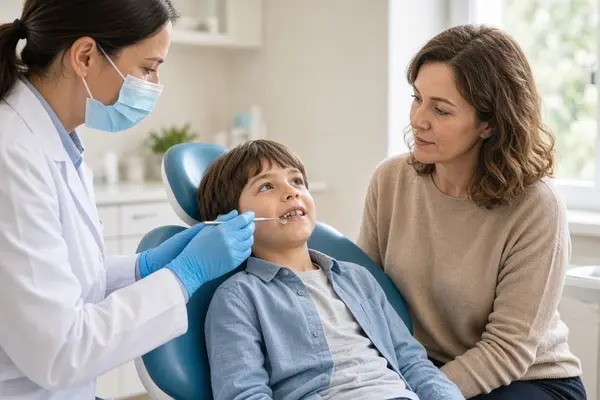
The Follow-Up Schedule Nobody Mentions
The injury isn't over when the composite is cured. IADT sets follow-up for an enamel-dentin fracture in a permanent tooth at 6 to 8 weeks and 1 year. For a pulp-exposed permanent tooth it's 6 to 8 weeks, 3 months, 6 months, and 1 year. For a pulp-exposed baby tooth it's 1 week, 6 to 8 weeks, and 1 year.
We book these before you leave. It's also why we may recommend rinsing with 0.12% chlorhexidine gluconate and brushing the area carefully afterward, which the same guideline calls for.
What Not to Do
Don't file or sand the sharp edge at home. Don't rub aspirin on the gum, because it burns the tissue. Don't scrub the fragment clean. Don't let it dry out on the kitchen counter. Don't push a loose or displaced tooth back into place with your fingers. And don't try to replant a knocked-out baby tooth.

Do Mouthguards Actually Prevent Chipped Teeth?
For sports, yes, and the numbers are good. The American Dental Association reports injury risk 1.6 to 1.9 times higher in team contact sport players who didn't wear one, and in basketball a dental injury rate of 0.67 per 1,000 exposures without a mouthguard against 0.12 with one.
My caveat: a stock boil-and-bite guard that your child spits out on the bench protects nobody. Fit and whether they keep it in are the whole story. And most chips I see in kids under 5 have nothing to do with sports. They fall, at home, on furniture. No mouthguard helps a 2-year-old who trips into a coffee table, so for that age the honest prevention is corner guards and shoes with grip.
What Affects the Cost of Fixing a Chipped Tooth
Cost tracks the depth of the fracture, not how bad the chip looks. Smoothing an enamel edge is the smallest thing we do. Composite bonding sits in the middle. A pulpotomy plus a crown is the largest.
Three things move the number. How many teeth are involved? Whether sedation is needed to finish the repair in one visit rather than two. And whether the original fragment can be reattached instead of rebuilt from scratch, which is the best argument for bringing that piece with you. We take all major private insurances, and families without dental coverage can use the Mini Miners Membership Plan. Call and we'll price your child's actual injury before we touch anything.
If your child chipped a tooth today, call 303-500-3202. Patients of record who reach us after hours can press 2 for the on-call dentist, and we'll tell you on the phone whether this is a tonight problem or a tomorrow problem.
FAQs
What should I do if my child chipped a tooth but there's no pain?
Rinse the mouth with warm water, look at the chip in good light, and check for a yellow patch or a pink dot. A rough white edge with no color change and no pain is enamel only and can wait a few days. A yellow patch means dentin is exposed, and that should be sealed within 24 to 48 hours even without pain.
Will a child's chipped tooth grow back or heal on its own?
No. Enamel has no living cells, so it cannot regrow or repair itself the way a bone or a cut does. The sharp edge can wear smoother over weeks, which fools some parents into thinking it healed, but the lost structure stays lost. Only bonding, a crown, or reattaching the original fragment restores it.
How do I know if a chipped tooth in a child needs same-day care?
Look for a pink or red dot in the middle of the chip, bleeding from the tooth itself rather than the gum, sharp pain from cold air, or a tooth that has moved or loosened. Any of those means same day. A pulp-exposed fracture is treated with a partial pulpotomy, and a 2022 review of 7 clinical studies reported success rates of 75% to 96%.
Can a chipped baby tooth just be left alone until it falls out?
Not if dentin or pulp is exposed. The IADT guideline calls for sealing exposed dentin in a primary tooth and treating a pulp exposure with a partial pulpotomy, with follow-up at 1 week, 6 to 8 weeks, and 1 year. An untreated exposure lets bacteria reach the nerve, and children often show no pain even when infection is present.
What should I put the broken piece of tooth in?
Water or saline, in any clean container. The 2020 IADT guideline says a fragment that has dried out gets rehydrated in water or saline for 20 minutes before bonding. Milk is the correct storage medium for a whole tooth that was knocked out, because it protects the living ligament cells on the root, and a chip of enamel has none of those.
How much does it cost to fix a chipped tooth in a child?
Cost tracks the depth of the fracture. Smoothing an enamel edge is the smallest treatment, composite bonding sits in the middle, and a pulpotomy with a crown is the largest. Three things move the number: how many teeth are involved, whether sedation is needed, and whether the original fragment can be reattached. Mini Miners accepts all major private insurances, and the Mini Miners Membership Plan covers families without dental coverage.


Comments