Kids Swallowing Fluoride Toothpaste: How Much Is Too Much
Written By: Logan Grover, Content Writer |
Reviewed By: Dr. Alison Grover, Board-Certified Diplomate Pediatric Dentist |
Last Reviewed: October 5, 2026 |
Kids swallowing fluoride toothpaste is normal, and at the recommended amount it's safe. A rice-grain smear holds about 0.1 mg of fluoride. A 33-pound toddler would have to swallow about 2.5 ounces of paste at once to reach the dose the American Academy of Pediatric Dentistry (AAPD) calls "probably toxic." That's roughly 700 smears. Swallowing a little every day is a separate question. The main risk there is fluorosis, white flecks on the adult teeth, and that risk ends around age 8. Where kids go over is the amount on the brush. In a CDC survey of parents, more than 38% of kids aged 3 to 6 used a half or full brush load instead of a pea.

Is It Safe for Kids to Swallow Fluoride Toothpaste?
Swallowing fluoride toothpaste is safe for kids when the amount matches their age. The American Dental Association (ADA) recommends a rice-grain smear, about 0.1 mg of fluoride, from the first tooth to age 3. From 3 to 6, it's a pea-sized amount, about 0.25 mg. Trouble comes from much bigger amounts, swallowed at once or every day for years.
Toddlers swallow most of what's on the brush, and that's expected. The CDC's 2001 fluoride recommendations say children under 6 swallow an average of 0.3 g of toothpaste per brushing, and as much as 0.8 g.
Age | Amount | Paste | Fluoride | Can they spit? |
First tooth to age 3 | Smear, the size of a rice grain | About 0.1 g | About 0.1 mg | Usually not. Expect a swallow |
3 to 6 | Pea-sized | About 0.25 g | About 0.25 mg | Learning. Watch and have them spit |
Amounts from the ADA and the AAPD.
Neither the ADA nor the AAPD sets a separate amount after age 6. At Mini Miners, we keep kids on a pea-sized amount through age 7 and ask parents to help with brushing until about age 8. That matches the fluorosis window: the CDC says the enamel on adult teeth is fully formed by about age 8.
How Much Toothpaste Would a Child Have to Swallow to Get Sick?
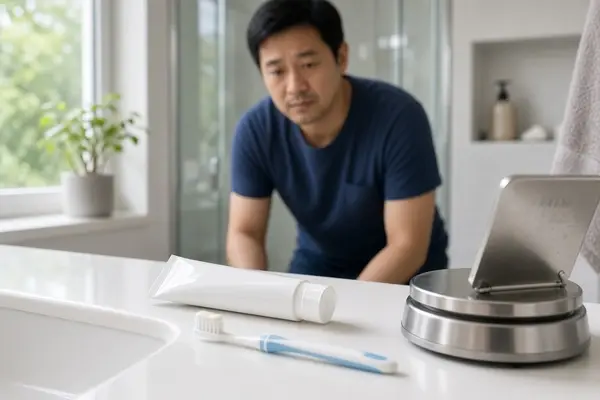
Far more than a brushing. The AAPD puts the probably toxic dose at 5 mg of fluoride per kilogram of body weight. Smaller doses may upset the stomach, and higher doses may cause seizures or muscle spasms called tetany, the AAPD notes.
Standard fluoride toothpaste in the US has 1,000 to 1,100 parts per million (ppm) of fluoride, according to the CDC. That's about 1 mg of fluoride in every gram of paste. Here's how much regular paste it takes to reach the probably toxic dose:
Child's weight | Fluoride at the probably toxic dose | Regular paste that holds it | Rice-grain smears | Peas |
22 lb (10 kg) | 50 mg | 1.6 to 1.8 oz (45 to 50 g) | About 450 to 500 | About 180 to 200 |
33 lb (15 kg) | 75 mg | 2.4 to 2.6 oz (68 to 75 g) | About 680 to 750 | About 270 to 300 |
44 lb (20 kg) | 100 mg | 3.2 to 3.5 oz (91 to 100 g) | About 910 to 1,000 | About 360 to 400 |
Calculated from the AAPD's 5 mg/kg probably toxic dose and the CDC's 1,000 to 1,100 ppm range.
Compare those amounts with the net weight printed on your tube. Poison Control's own summary: small, accidental swallows of over-the-counter fluoride toothpaste "are unlikely to be toxic."
The tube to lock up is prescription paste. Prescription toothpaste such as PreviDent 5000 Kids has about 5,000 ppm of fluoride, 4.5 to 5 times regular paste. The AAPD recommends it for higher-risk kids 6 and older, and its label says not to use it under age 6 unless a dentist or physician recommends it. For a 33-pound child, about 0.5 oz (15 g) reaches the probably toxic dose.

What to Do if Your Child Ate Toothpaste
Find out how much is gone, and call Poison Control if it's more than a brushing amount. The FDA requires this warning on every over-the-counter fluoride toothpaste: "If more than used for brushing is accidentally swallowed, get medical help or contact a Poison Control Center right away."
Take the tube away. Estimate how much is missing against the net weight on the label.
Don't make your child throw up, which Poison Control advises against.
Offer milk or yogurt. The calcium binds with fluoride and settles an upset stomach, per Poison Control.
Call Poison Help at 1-800-222-1222, or use webPOISONCONTROL online, if more than a brushing amount is gone or your child ate more than a taste of prescription paste. The federal line is toll-free, open 24 hours a day, and connects you to your local poison center.
Call 911 if your child has a seizure, muscle spasms, or is hard to wake.
Poison Control is the right first call for a swallowed tube, day or night. Current Mini Miners patients can reach our on-call dentist at (303) 500-3202 by pressing 2, and that line is for dental emergencies.

Can Kids Swallowing Fluoride Toothpaste Every Day Get Fluorosis?
Only if the daily amount runs well past the guidance while adult teeth are still forming, which ends around age 8. At a smear or a pea, toothpaste alone stays well under the federal daily limit, even if your child swallows all of it.
The National Academies set daily upper limits for fluoride from all sources combined. The NIH Office of Dietary Supplements lists them as 1.3 mg a day for ages 1 to 3 and 2.2 mg for ages 4 to 8. If your child swallows every bit of paste, twice a day, here's where toothpaste alone lands:
Smear: about 0.2 mg a day, 15% of the limit for ages 1 to 3
Pea: about 0.5 mg a day, 38% of the ages 1 to 3 limit and 23% of the ages 4 to 8 limit
0.8 g per brushing, the most the CDC says kids under 6 may swallow: about 1.6 to 1.8 mg a day, more than the whole limit for ages 1 to 3 before any water or food
The CDC describes fluorosis as white flecks, spots, or lines on the enamel. It isn't painful and doesn't change how teeth work. In the US, it's mostly mild. When CDC researchers examined teens aged 12 to 15 (1999 to 2004 data), 41% had some fluorosis. About 9 in 10 of those cases were very mild or mild, and 3.6% of teens had the moderate or severe kind.
White spots can also be early decay, so have new ones checked. Our page on white spots on teeth covers the other common causes and the resin treatment we use.
Where Kids Go Over: The Amount on the Brush
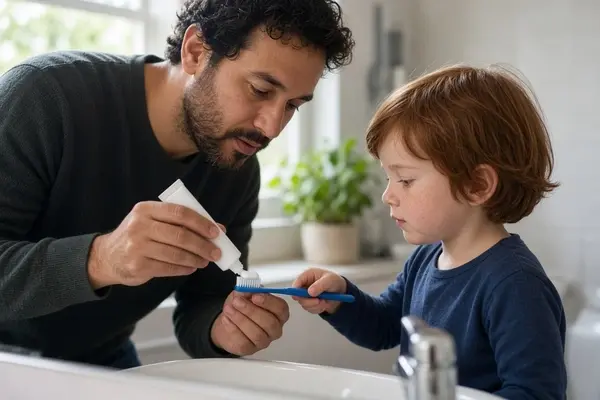
At a smear or a pea, swallowing is fine. Trouble starts when the brush gets loaded. In a 2019 CDC report on national survey data from 2013 to 2016, parents said more than 38% of kids aged 3 to 6 used more than the recommended amount: 20.6% used a half load and 17.8% a full load.
The Texas Attorney General argued that box pictures showed too much paste. Under agreements with his office, Colgate began updating its kids' fluoride toothpaste images to a pea-sized amount starting Nov 1, 2025, online first, for its Colgate, Tom's of Maine, and hello brands. Crest's updated kids' packaging began rolling out Jan 1, 2026.
What keeps the amount right at home:
You hold the tube until age 3. Parents should dispense the paste for kids under 3, according to the AAPD.
Spit, don't rinse. We ask kids to spit out the extra paste after brushing. The AAPD says rinsing after brushing "should be kept to a minimum or avoided altogether," so the fluoride stays on the teeth.
Let them practice, then take a turn. Let your child brush first, then finish by brushing their teeth yourself.
Plan for the fight. If your toddler battles the brush, our toddler brushing guide has a section on what to do.
Why Swallowing Isn't a Reason to Switch to Fluoride-Free Toothpaste
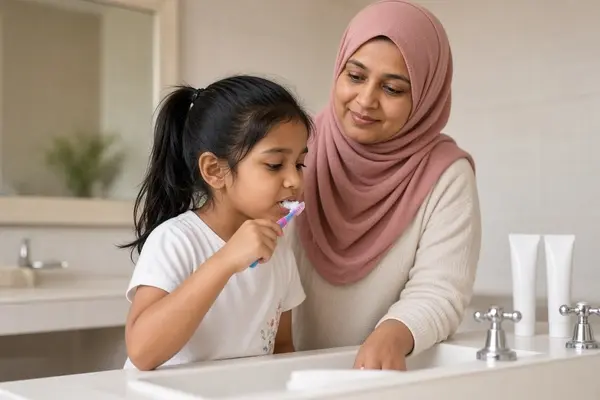
Swallowing alone isn't a reason to drop fluoride. The smear amount is small enough for a child who can't spit yet.
The ADA ran the math for a 33-pound (15 kg) child who swallows the whole smear twice a day. That's 0.013 mg of fluoride per kilogram per day, about 26% of the 0.05 mg per kilogram level from the National Academies that the ADA cites.
Taking the fluoride out costs protection. A 2003 Cochrane review of 70 trials with 42,300 children found fluoride toothpaste cut decay in permanent teeth by 24% compared with a paste without fluoride. A fluoride-free training paste gives up that protection, and your child still has to learn to spit. That's why we recommend fluoride toothpaste at home.
There's 1 case where a pediatric dentist may suggest fluoride-free for a short stretch: a baby at low cavity risk who is still getting used to a toothbrush. We cover it in our post on fluoride vs fluoride-free toothpaste.

Erie Tap Water vs a Swallowed Smear
A swallowed smear carries about as much fluoride as 4 ounces of Erie tap water. Erie has added fluoride to its water since October 27, 2008, after voters approved Ballot Question 2A that April.
The town's 2026 water quality report lists fluoride at 0.82 mg per liter, from a 2023 sample. At that level:
Fluoride source | Fluoride | Same as this much Erie tap water |
1 rice-grain smear | About 0.1 mg | About 4 oz |
1 pea | About 0.25 mg | About 10 to 11 oz |
0.8 g swallowed in 1 brushing | About 0.8 to 0.9 mg | About 33 to 36 oz |
This also puts the IQ headlines in scale. In 2024, the National Toxicology Program reported moderate confidence that drinking water above 1.5 mg per liter is linked to lower IQ in children. It found too little data to judge 0.7 mg per liter, the US recommended level, and it didn't evaluate toothpaste on its own. Erie's 0.82 mg per liter is about 55% of that 1.5 mark.
Well water and bottled water aren't covered by the town report. The CDC says to test well water through a state-certified lab, and to ask a filter maker whether its filter removes fluoride. If your home has well water or you drink bottled water, ask us whether your child is getting enough fluoride. Some children may need fluoride supplements or treatments.
Fluoride varnish is a separate dose, applied by the dentist. We apply it at the end of the appointment, and your child picks the flavor off a menu, with a flavorless option too. The varnish hardens when it touches saliva, so kids can eat and drink normally right after. It's part of our fluoride treatment in Erie.

What Changed in 2025 and 2026, and What Didn't
The FDA's 2025 fluoride actions targeted swallowed drops and tablets. Toothpaste guidance hasn't changed, though the pictures on some kids' boxes have.
May 13, 2025: the FDA began moving prescription fluoride drops and tablets for kids off the market. Its announcement drew the line itself: "Unlike toothpaste with fluoride or fluoride rinses, these products are swallowed and ingested by infants and toddlers."
Oct 31, 2025: the FDA announced actions to restrict those swallowed products for kids under 3 and for older kids at low or moderate cavity risk, and sent notices to 4 companies.
February 2026: the ADA's toothpaste guidance, last updated that month, still calls for a smear from the first tooth.
So a smear is still a smear. If your child takes prescription drops or tablets, ask at the next visit whether they still fit.
Kids swallowing fluoride toothpaste is expected under age 3, and at a smear it's safe. Hold the tube yourself and keep the amount small. Save 1-800-222-1222 for the day a tube goes missing. To have us check your child's brushing and fluoride needs, call (303) 500-3202 or text (720) 734-5890. Mini Miners Pediatric Dentistry is at 61 Erie Pkwy, Unit 101, in Erie Commons.
FAQs
Is kids swallowing fluoride toothpaste dangerous?
Not at the recommended amounts. The ADA's smear for kids under 3 holds about 0.1 mg of fluoride, and the AAPD's probably toxic dose is 5 mg per kilogram of body weight. A 33-pound toddler would have to swallow about 2.5 ounces of regular paste at once to reach it.
How much fluoride toothpaste is toxic to a child?
The AAPD puts the probably toxic dose at 5 mg of fluoride per kilogram of body weight. Standard US toothpaste has about 1 mg of fluoride per gram, so a 22-pound child would need to swallow about 1.6 to 1.8 ounces of regular paste at once. Prescription paste with 5,000 ppm reaches that dose with far less.
What should I do if my toddler ate a lot of toothpaste?
Don't make your child throw up, and offer milk or yogurt for an upset stomach. Call Poison Help at 1-800-222-1222 if more than a brushing amount is gone or if your child ate more than a taste of prescription paste. Call 911 for a seizure, muscle spasms, or a child who is hard to wake.
Should kids swallowing fluoride toothpaste switch to fluoride-free?
Usually not. A 2003 Cochrane review of 70 trials found fluoride toothpaste cut decay in permanent teeth by 24%. For a 33-pound child, a smear swallowed twice a day comes to about 26% of the safety level the ADA cites, so shrink the amount instead of dropping the fluoride.
Is adult toothpaste more dangerous for kids than kids' toothpaste?
Most regular adult and kids' fluoride toothpastes in the US use the same standard strength, 1,000 to 1,100 ppm, according to the CDC. Prescription paste is different: about 5,000 ppm, labeled for age 6 and up unless a dentist or physician says otherwise. Keep it out of reach.
At what age can kids spit out toothpaste?
Usually around age 3, which is when the ADA moves kids from a smear to a pea. We ask kids to spit out the extra paste after brushing. The FDA-required label tells parents to teach and supervise children under 6.
Does Erie's tap water add to the fluoride my child swallows?
Yes, a little. Erie's 2026 water report lists 0.82 mg of fluoride per liter, so an 8-ounce cup carries about 0.19 mg, about 2 smears' worth. The rice-grain and pea-sized toothpaste amounts stay the same either way.


Comments