What A Comprehensive Pediatric Dental Exam Really Covers, And How We Do It For Nervous Kids
Updated: Oct 6
Written By: Logan Grover, Health Content Writer |
Reviewed By: Dr. Alison Grover, Board-Certified Diplomate Pediatric Dentist |
Last Reviewed: Aug 01, 2026 |
A comprehensive pediatric dental exam is a full check of your child's teeth, bite, gums, jaw growth, and mouth habits, plus a cleaning, fluoride, and a plan for what comes next. It is more than scraping off plaque. One thing became clear after my husband and I built Mini Miners from four patients in 2017 into the Erie, Colorado practice we run today: the exam is only as good as what your child will let us do. A crying, clamped-shut three-year-old does not get a full exam. So we flipped the order. We get kids comfortable first, then do the careful part. We call it a Happy Visit, and it is why nervous kids leave here having actually been seen.

What Is a Comprehensive Pediatric Dental Exam?
A comprehensive pediatric dental exam is a complete evaluation of a child's oral health: the teeth, gums, bite, jaw development, and habits such as thumb-sucking, plus a cleaning, fluoride, and any needed x-rays. Unlike a quick cleaning, it reviews medical history, tracks growth over time, and screens for problems before they hurt or spread.
The American Academy of Pediatric Dentistry treats this as the baseline childhood visit, not an upgrade. On a dental bill it usually shows up as the comprehensive oral evaluation. For a first visit, we also set up what dentists call a dental home, which just means one place that knows your child and their history and is ready when something goes wrong. This exam is a core part of what pediatric dentistry does for kids.

Why a Thorough Exam Depends on a Calm Child
The most common reason a child does not get a complete exam is not a hidden cavity. It is that the child will not open up.
I will push back on the usual advice to power through and finish everything on the first visit. For a scared toddler, forcing it teaches them that the dentist is where scary things happen, and the next three visits get harder. The AAPD's own behavior guidance supports non-drug techniques like tell-show-do and desensitization for this exact reason. In my chair, a staged approach gets a better exam within a visit or two than a forced one gets today.
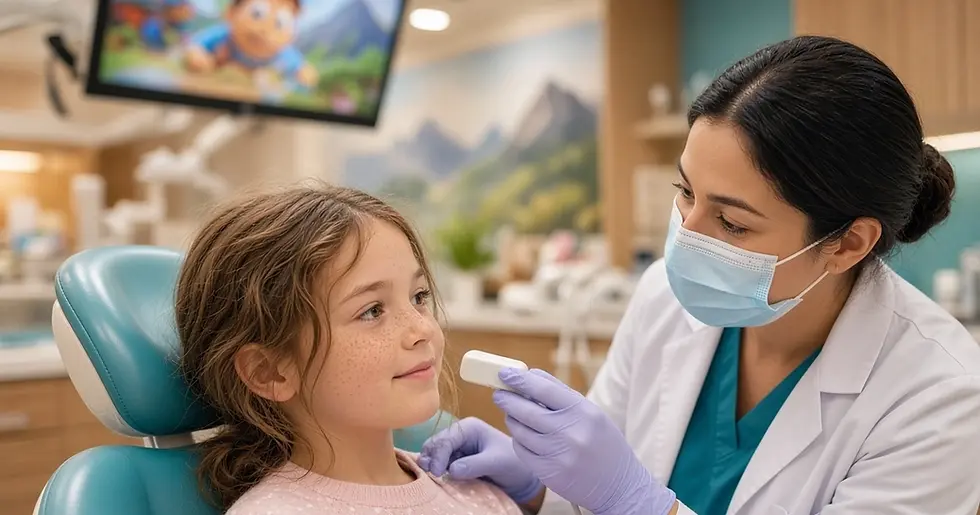
A Happy Visit is a real appointment with no treatment. Your child explores the room, meets the mirror and the little tooth counter, picks a movie, and sits in the chair only if they want to. Kids who walk in scared of the dentist often let us do a full exam the very next time, because the room is no longer a mystery.

What Happens During Your Child’s Exam
Our exam runs in the same order every time, so kids know what is coming.
History and warm-up: we go over medical history, medicines, and past visits, then let your child pick a toothpaste and fluoride flavor. Everything we use is kid-sized, down to the instruments and the x-ray sensors, and we keep a baby bed for our youngest patients.
The cleaning: we remove the plaque and tartar a home brush misses. That is the cleaning itself, one step inside the larger exam, not the whole visit.
Tooth-by-tooth check: we look at every surface for decay, weak enamel, and early white spots.
Bite and growth: we watch how teeth are erupting, how the jaw lines up, and whether a tongue-tie is affecting feeding or speech.
X-rays only if needed: we take digital images right in the room so your kid never leaves their movie. Digital sensors use less radiation than film, per the American Dental Association, and we take them only when they will change what we do.
Fluoride: a quick fluoride varnish, which the US Preventive Services Task Force recommends for young kids starting when the first teeth come in. We use one your child can eat and drink right after, so there is no waiting.
Plan and questions: we walk you through what we saw and what is next. Most first visits run short on purpose.

What We Are Looking For, and What We Catch Early
A cleaning finds what is on the surface. A full exam finds what is coming.
Cavities are the most common chronic disease of childhood, and the CDC reports that sealants block about 80% of cavities in back teeth for the first two years and keep protecting after that, while kids without sealants get almost three times more first-molar cavities. Catching decay at the white-spot stage often lets us stop it with Silver Diamine Fluoride or improve the look with ICON, with no drill and no shot.
We also flag what a rushed visit skips: a tongue-tie that is slowing speech, a bite that points to early orthodontic needs, or a molar that would do better with a Hall crown, which slips over the tooth without numbing or drilling. Small problems caught early stay small. We check for tongue-ties as early as the newborn stage and release them with a soft tissue laser when they interfere with feeding or speech.
How Often Should Kids Get a Comprehensive Pediatric Dental Exam?
Most kids need one every six months, starting by their first birthday. Higher-risk kids need them more often.
The American Academy of Pediatric Dentistry recommends a first visit by age one or within six months of the first tooth, then a checkup every six months for most children. Kids with past cavities, special health needs, or a high-sugar diet may need a tighter schedule. We set the interval from your child's real risk, which is the point of good preventive care. The way I explain the six-month rhythm to parents: decay can take hold on a baby tooth in about that time, so a longer gap gives small problems room to grow.

What Does a Comprehensive Pediatric Dental Exam Cost?
If you have dental insurance, exams and cleanings are usually covered and we bill your plan directly. If you do not, here is exactly what we charge, with no guessing.
Our membership for families without insurance bundles the routine care into one yearly price:
What is included each year | Toddler plan (first tooth to age 3) | Kid plan (age 4 and up) |
Doctor exams | 2 | 2 |
Cleanings | 2 | 2 |
Fluoride treatments | 2 | 2 |
Needed x-rays | Included | Included |
Emergency exam | 1 | 1 |
Discount on other treatment | Up to 20% | Up to 20% |

Getting an Anxious or Special-Needs Child Through the Exam
Some kids need more than a friendly room, and that is fine.
Parents are always welcome in the treatment room here, which is not true everywhere. Kids pick from more than 70 movies on the ceiling TVs. Every treatment room is plumbed for nitrous oxide, and when a child needs more we offer sedation options at every level, from mild to moderate to deep, matched to the child and the treatment. For kids with special needs, we build a sensory-aware plan around what that specific child can handle. Our chairs recline fully or stay partly upright, whichever a child will accept.
This is the part of the job I trained for. My degree from Wellesley College is in child psychology, and I am a board-certified Diplomate of the American Board of Pediatric Dentistry who completed the pediatric residency at UCLA. That mix, how kids think plus how their mouths grow, is the reason we run visits the way we do.
A comprehensive pediatric dental exam looks the same on paper wherever you go. The real difference is whether your child will sit still for it, because an exam a kid actually tolerates is the one that catches the small stuff early. We are in the Erie Commons shopping area at Briggs Street and Erie Parkway, between I-25 and 287, a few minutes from most local schools, and we see families from Lafayette, Louisville, Boulder, Broomfield, and Longmont. If your child is due, or the last visit somewhere else went badly, start with a Happy Visit and let us earn the hard parts.
FAQ
What is a comprehensive pediatric dental exam?
It is a full evaluation of a child's teeth, gums, bite, and jaw development, along with a cleaning, fluoride, and any needed x-rays. It also covers medical history and habits like thumb-sucking. Unlike a quick cleaning, it screens for problems early and tracks how your child's mouth is growing.
How is a comprehensive pediatric dental exam different from a regular cleaning?
A cleaning removes plaque and tartar. A comprehensive pediatric dental exam adds a tooth-by-tooth check, a bite and growth review, x-rays when needed, fluoride, and a written plan. The cleaning is one step inside the larger exam.
At what age should my child have their first dental exam?
The American Academy of Pediatric Dentistry recommends the first visit by age one, or within six months of the first tooth. Starting early sets up a dental home and lets us catch decay before it spreads. First visits are short and mostly about comfort.
How often do children need a dental exam?
Most children should be seen every six months, per AAPD guidance. Kids with a history of cavities, special health needs, or higher risk may need more frequent visits. We set the interval based on your child's risk, not a one-size rule.
Are dental x-rays safe for children?
Yes, when used selectively. We take digital x-rays only when needed, and digital sensors use less radiation than traditional film, per the American Dental Association. We take them in the treatment room so your child stays comfortable.
What if my child is scared or has special needs?
We start with a Happy Visit, with no treatment, just time to explore the office and meet the tools. Parents are welcome in the room, and we offer sedation options when they help. For kids with special needs, we build an individualized, sensory-aware approach.


Comments