How Much Toothpaste For Kids: What The Tube Doesn't Tell You
Written By: Logan Grover, Content Writer |
Reviewed By: Dr. Alison Grover, Board-Certified Diplomate Pediatric Dentist |
Last Reviewed: October 11, 2026 |
How much toothpaste for kids depends on age, not brand. From the first tooth until age 3, use a smear of fluoride toothpaste the size of a grain of rice. From 3 to 6, use a pea-sized amount. The American Dental Association (ADA), the American Academy of Pediatric Dentistry (AAPD) and the CDC give the same 2 amounts. Picking the paste is the easy part. The amount is where families slip. In a CDC survey of 5,157 children, 38.4% of kids aged 3 to 6 used more than recommended. The tube adds to the mix-up, because its label tells parents of kids under 2 to ask a dentist. Our answer is yes, starting with the first tooth.

How Much Toothpaste for Kids, by Age
The right amount of toothpaste for kids is a rice-grain smear of fluoride paste from the first tooth to age 3, then a pea-sized amount (about 0.25 grams) from 3 to 6. That's about 0.1 mg and 0.25 mg of fluoride (AAPD). Kids' and adult pastes share 1 FDA strength range, so the amount sets the dose.
Age | How much | Fluoride per brushing | Your job |
First tooth to age 3 | A smear the size of a grain of rice | About 0.1 mg | Put it on the brush and do the brushing |
Age 3 to 6 | A pea, about 0.25 g | About 0.25 mg | Put it on the brush and help them brush |
Age 6 and up | No new amount set by the ADA, AAPD or CDC | Not set | Keep helping until around age 8 |
Amounts: ADA, AAPD (2023) and CDC. Weight: CDC. Fluoride per brushing: AAPD. Help until about age 8: Mini Miners.
The AAPD's fluoride guidance also says a parent should put the paste on the brush for children under 3.
Past age 6, none of the 3 sets a new amount. At Mini Miners, we keep kids on a pea-sized amount through age 7 and ask parents to help with brushing until around age 8.
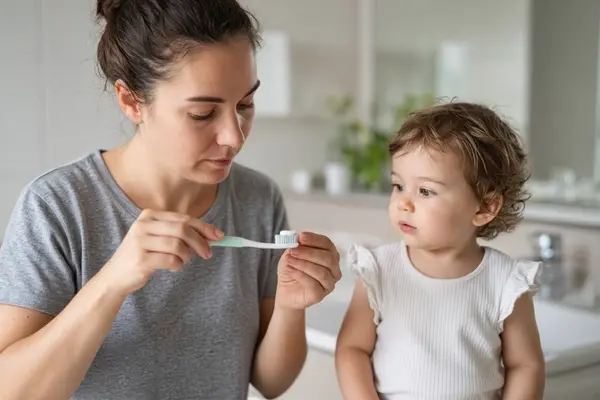
Why Does the Toothpaste Tube Say to Ask a Dentist for Kids Under 2?
The tube says it because the FDA requires that line on every fluoride toothpaste. Dental groups give a clear answer: start at the first tooth. The required direction, set by the FDA's labeling rule (21 CFR 355.50), reads: "Children under 2 years of age: Consult a dentist or doctor."
The line hands the decision to a dentist. It doesn't set an age limit.
And the dental answer changed in February 2014. Before then, the ADA recommended fluoride toothpaste only for kids 2 and older. Its Council on Scientific Affairs then moved the start to the first tooth, with a rice-grain smear until age 3, in a report in the Journal of the American Dental Association. The AAPD's 2023 guidance and the CDC say the same thing today.
So this is where we push back on the box. If your baby has teeth, brush them twice a day with a smear of fluoride toothpaste. Don't wait for a 2nd birthday. The first tooth is the start date, and the CDC notes it can show up as early as 6 months.

Do Most Kids Use Too Much Toothpaste?
Close to 4 in 10 do. In the CDC's survey (data from 2013 to 2016), 20.6% of kids aged 3 to 6 used a half-loaded brush and 17.8% used a full one. Nearly 80% of kids aged 3 to 15 also started brushing later than recommended.
Too much fluoride while teeth are forming can cause dental fluorosis. The CDC describes it as white flecks, spots or lines on the enamel, and says it's mostly mild and cosmetic in the US. It doesn't hurt and doesn't affect how the tooth works. Our post on white spots covers fluorosis and 4 other causes, so have a dentist look before you assume.
The window closes. By about age 8, the enamel on permanent teeth is fully formed, and the CDC says older children can't get fluorosis. We ask parents to help with brushing until around age 8, and the timing matches.
Packaging is changing too. In September 2025, Colgate agreed with the Texas Attorney General to show a pea-sized amount on packaging for its under-6 fluoride toothpastes, starting November 1, 2025. Crest's maker reached its own agreement in January 2026. Keep 1 detail in mind: a pea is the amount for ages 3 to 6. For a child under 3, it's 2.5 times the fluoride the AAPD recommends (0.25 mg vs 0.1 mg).

Swallowing Toothpaste: What's Normal and When to Call
Some swallowing is expected in kids who can't spit yet, and the label tells you when it's too much. The AAPD's rice-grain smear holds about 0.1 mg of fluoride, and the AAPD calls for supervised brushing for any child who can't spit yet.
The FDA-required warning on every fluoride toothpaste reads: "If more than used for brushing is accidentally swallowed, get medical help or contact a Poison Control Center right away." The national Poison Help line is 1-800-222-1222. The same label says to keep fluoride toothpaste out of reach of children under 6, so store it where your child can't get to it.

Kids' Toothpaste Isn't Weaker Than Adult Toothpaste
Kids' fluoride toothpaste and adult fluoride toothpaste fall in the same strength range in the US. The FDA's rule for over-the-counter cavity-protection toothpaste (21 CFR 355.10) allows 850 to 1,150 ppm fluoride for standard pastes, and it doesn't set a weaker strength for children.
So a kids' label doesn't mean less fluoride per squeeze. The amount on the brush sets the dose, which is why the rice-grain and pea-sized rules exist.
What to Look for in a Kids' Toothpaste
Look for fluoride on the label and the ADA Seal, then pick a flavor your child will accept twice a day.
Fluoride in the Drug Facts box. The active ingredient should read sodium fluoride, sodium monofluorophosphate or stannous fluoride. Those are the 3 fluoride actives the FDA rule allows in toothpaste.
The ADA Seal. For a fluoride paste to earn it, the ADA requires lab tests showing the fluoride is available to the teeth, and caries trials of at least 2 years for new formulas.
A flavor they'll use. At Mini Miners, kids select their own toothpaste and fluoride flavors, and there's a flavorless fluoride option too.
No fluoride-free "training" paste once teeth are in. It has no fluoride, and the ADA and AAPD recommend fluoride from the first tooth. Our post on fluoride-free toothpaste covers when it might make sense.

Is Hydroxyapatite Toothpaste a Good Swap for Kids?
It shows promise, but the evidence in children comes down to 1 trial, and fluoride has decades more data behind it. In a 2021 trial published in Scientific Reports, 207 children aged 3 to 7 in Poland were assigned a hydroxyapatite paste or a fluoride paste for 336 days. Among the 177 who finished, new or worsening enamel lesions showed up in 72.7% of the hydroxyapatite group and 74.2% of the fluoride group. That met the study's bar for being no worse than fluoride.
3 caveats matter before you switch. The fluoride paste in the study had 500 ppm fluoride, below the 850 ppm floor for US pastes. The maker of the hydroxyapatite paste funded the trial. And the ADA's Seal category for fluoride toothpaste doesn't cover fluoride-free pastes.
If your family uses a fluoride-free paste, mention it at your child's next checkup.
Fluoride in Erie's Water
Erie adds fluoride to its tap water, and your child still needs fluoride toothpaste. According to the Town of Erie's fluoride fact sheet, voters approved fluoridation with Ballot Question 2A on April 1, 2008, and the town began adding fluoride on October 27, 2008. The town's 2025 water quality report lists 0.82 ppm at the entry point to the system, from a single 2023 sample. The CDC's recommended level is 0.7 mg/L.
Water and toothpaste work as a pair. The ADA, AAPD and CDC amounts apply to every child with teeth, with no exception for fluoridated water.
Fluoride has been in the news since 2025, but the toothpaste amounts haven't changed. Utah and Florida stopped community water fluoridation in 2025; Colorado has no statewide ban. On October 31, 2025, the FDA limited swallowed fluoride supplements to children 3 and older who are at high risk for cavities and lack fluoridated water. Toothpaste wasn't part of that decision.
If your home runs on a private well or your family drinks bottled water, ask us whether your child needs fluoride supplements or treatments. If you drive in from Lafayette, Longmont or another town, check that town's own water quality report, because each water system reports its own level.

Brushing Habits That Make the Amount Work
Spit, don't rinse, and keep helping until around age 8. The AAPD says rinsing after brushing should be kept to a minimum or skipped, and we ask kids to spit out the extra paste instead.
Frequency counts too. In the CDC's survey, 60.5% of kids aged 3 to 15 brushed twice a day. We ask for 2 minutes, twice a day, in the morning and before bed. Our guide on how to brush a toddler's teeth walks through technique by age.
At checkups, we apply fluoride varnish in Erie at the end of the visit. It hardens when it touches saliva, so your child can eat and drink normally right after. That's not the norm. Dental products maker Young Innovations compiled the care instructions for 10 varnish brands, and most ask families to skip hard foods and hot drinks for 4 to 6 hours.
How much toothpaste for kids comes down to 2 sizes: a rice grain until age 3 and a pea after that, with fluoride from the first tooth. If you're not sure your child's amount is right, ask at the next checkup. Call (303) 500-3202 or text (720) 734-5890 to book at 61 Erie Pkwy, Unit 101, in Erie.
FAQs
How much toothpaste for kids under 3 is safe?
A smear the size of a grain of rice, starting with the first tooth. The AAPD puts that at about 0.1 mg of fluoride, and a parent should put it on the brush. The AAPD also calls for supervised brushing for children who can't spit yet.
How much toothpaste for kids aged 3 to 6?
A pea-sized amount, which the CDC puts at about 0.25 grams. That holds about 0.25 mg of fluoride. In a CDC survey, 38.4% of kids in this age group used more than that.
Can my child use adult toothpaste?
Yes, in the right amount. In the US, kids' and adult fluoride toothpastes fall in the same FDA range of 850 to 1,150 ppm for standard pastes, so the amount on the brush sets the dose. Use a rice-grain smear until age 3 and a pea-sized amount from 3 to 6 either way.
Should kids rinse after brushing?
No, or as little as possible. The AAPD says rinsing after brushing should be kept to a minimum or skipped. Have your child spit out the extra paste instead.
When can my child brush without help?
At Mini Miners, we tell parents to keep helping until around age 8. The CDC says permanent-tooth enamel is fully formed by about age 8, and older children can't get dental fluorosis.
What should I do if my child eats toothpaste?
The FDA-required label draws the line at more than the amount used for brushing. If your child swallows more than that, get medical help or contact a Poison Control Center right away. The national Poison Help line is 1-800-222-1222.
Do kids in Erie need fluoride toothpaste if the water has fluoride?
Yes. Erie has added fluoride to its water since October 27, 2008, and the town's 2025 water report lists 0.82 ppm from a 2023 sample. The ADA, AAPD and CDC toothpaste amounts apply to every child with teeth, with no exception for fluoridated water.


Comments