Tooth Eruption In 2026: A Parent's Guide To Every Baby Tooth
Updated: Oct 6
Written By: Logan Grover, Health Content Writer |
Reviewed By: Dr. Alison Grover, Board-Certified Diplomate Pediatric Dentist |
Last Reviewed: May 14, 2026 |
Your baby's first tooth will probably break through the gums around 6 months old. The last of the 20 baby teeth should be in place by age 3. That's the tooth eruption at its simplest. But the window of "normal" is much wider than most parenting books suggest, and the gap between what parents expect and what actually happens causes a lot of unnecessary panic.
Tooth eruption is the process where primary teeth push through the gums in a predictable sequence. It starts with the lower front teeth around 6 months and finishes with the second molars by roughly 33 months. All 20 baby teeth play a role in speech, chewing, and guiding permanent teeth into the right position later.
I've worked on content for pediatric dental practices for years, and the number one concern parents raise at their baby's first dental visit is some version of "are my kid's teeth on schedule?" Almost always, the answer is yes.
When Does Tooth Eruption Actually Start?
Most babies cut their first tooth between 4 and 10 months. Six months is the rough average. But roughly 1 in 2,000 babies are born with a tooth already visible (called a natal tooth), and others won't see anything until well past their first birthday. Both situations are usually fine.
The AAPD's 2025 Reference Manual confirms that the standard eruption window is wide enough that bare gums at 9 months shouldn't alarm anyone. Genetics are the biggest factor here. If you or your partner teethed late, your baby probably will too.
Here's the benchmark that actually matters: the AAPD recommends a first dental visit by your child's first birthday or within 6 months of the first tooth (whichever comes first). According to CDC data cited in a 2024 Mordor Intelligence report, about 11% of U.S. children aged 2–5 already have untreated cavities in their baby teeth. Early visits catch problems before they compound.
What Order Do Baby Teeth Come In?
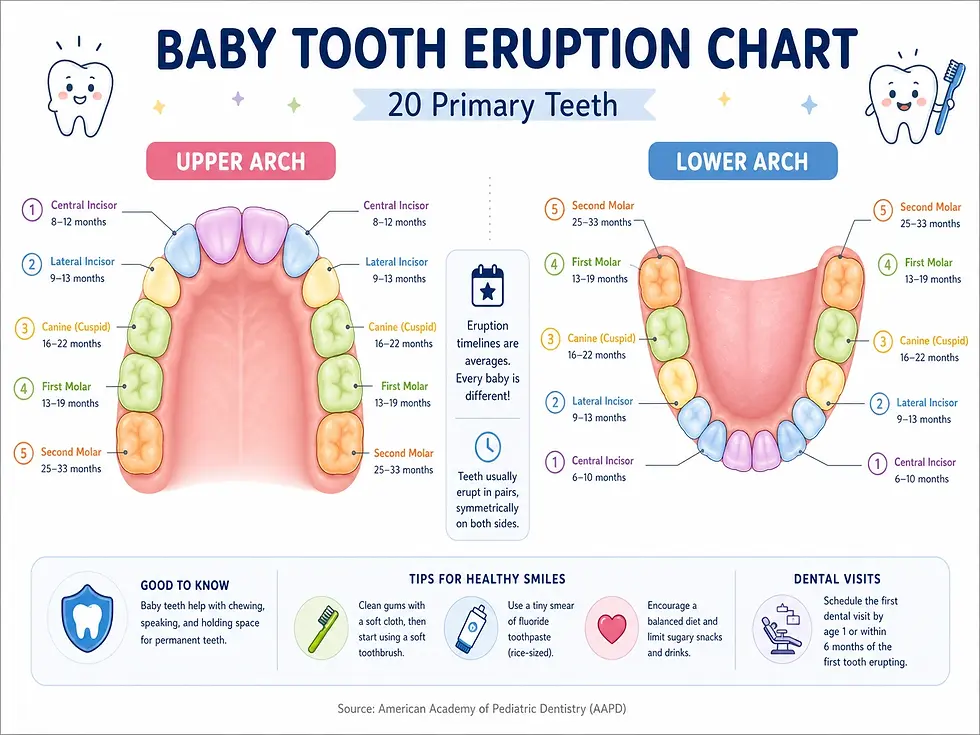
Tooth eruption follows a general pattern, though individual timing varies by months in either direction. Here's the typical sequence:
Lower central incisors (6–10 months): Almost always first. Your baby will drool more, chew on anything available, and get fussy. This is the textbook start of teething.
Upper central incisors (8–12 months): The front top teeth follow shortly after. This is when the toothy grin photos begin.
Lateral incisors (9–16 months): The teeth flanking the front four fill in next, upper and lower.
First molars (13–19 months): These cause more discomfort than incisors. Molars are bigger, and many parents report disrupted sleep during this stage.
Canines (16–23 months): The pointed teeth between incisors and molars. Their sharp edges pushing through gum tissue tend to increase fussiness.
Second molars (25–33 months): The final baby teeth. By age 3, most kids are all 20.
You can reference the ADA's official eruption charts for a visual breakdown, but don't treat those age ranges as deadlines. They're averages, not rules.
One contrarian point worth making: teething does not cause high fevers or diarrhea. A 2025 review from University of Utah Health pediatricians confirmed that teething produces mild gum irritation, drooling, and fussiness, but temperatures above 100.4°F or stomach problems point to something else. If your baby spikes a fever while teething, check for an ear infection or virus before blaming the teeth. I've seen parents delay medical care because they assumed "it's just teething," and that's a mistake.

Should You Worry About Delayed or Early Tooth Eruption?
Probably not. Some babies don't get their first tooth until 14 or 15 months and turn out perfectly fine. The range of normal is genuinely wider than pediatric milestone charts imply.
That said, if nothing has appeared by 18 months, it's worth seeing a pediatric dentist to rule out conditions like ankylosis (where a tooth fuses to bone) or supernumerary teeth (extra teeth blocking the path). These aren't common, but they do require early detection. The AAPD stresses radiographic assessment when an eruption is significantly off-schedule.
Early eruption is rarely a concern. A baby who cuts a tooth at 3 months is just on the fast end of the normal curve.
Asymmetry is the thing to actually watch. If one lower central incisor appears and the matching tooth on the opposite side lags by several months, mention it at your next visit. That pattern can sometimes signal a local issue worth investigating.
What About Eruption Cysts and Other Gum Changes?
Small bluish or translucent bumps on the gums are called eruption cysts. They look alarming. They're not. These are harmless fluid-filled sacs that form as a tooth pushes toward the surface, and they almost always resolve on their own when the tooth breaks through.
Severe swelling, persistent pain that doesn't respond to a chilled (not frozen) teething ring, or gum tissue that bleeds without explanation warrants a call to your dentist. Acetaminophen or ibuprofen, dosed per your pediatrician's guidance, handles most teething discomfort. Skip the topical numbing gels with benzocaine. The FDA warned against their use in children under 2 back in 2018, and a team that understands your practice's content would tell you the same thing we tell every client: when in doubt, stick with what the research supports.
Tooth eruption is one of those milestones that looks clean on a chart and feels messy in real life. Drool, tears, sleepless nights. It passes. The single most useful thing you can do is get your baby into a pediatric dental practice that monitors for early decay before their first birthday. Everything else (the timing, the order, the occasional eruption cyst) sorts itself out with professional oversight and a lot less worry than most parents put themselves through.
FAQs
How many teeth does a baby get in total?
Babies grow 20 primary teeth. These include 8 incisors, 4 canines, and 8 molars. The full set is typically in place by age 2.5–3. Each tooth serves a specific function for chewing, speech development, and holding space for the permanent teeth that come in later.
Does teething cause fever in babies?
No. A 2025 review from University of Utah Health pediatricians found that tooth eruption causes mild gum irritation and drooling, but not fevers above 100.4°F. If your baby has a fever during teething, it's more likely caused by an infection that happens to coincide with the timing.
When should a baby first see a dentist for tooth eruption concerns?
The AAPD recommends a first dental visit by age 1 or within 6 months of the first tooth eruption, whichever comes first. About 11% of U.S. children aged 2–5 already have untreated cavities, so early visits matter more than most parents realize.
What is an eruption cyst on a baby's gum?
An eruption cyst is a fluid-filled sac that forms on the gum as a tooth pushes toward the surface. It looks like a small bluish bump. In nearly every case, it resolves on its own once the tooth breaks through. No treatment is usually needed.
What should I do if my baby has no teeth by 12 months?
Don't panic. Some babies don't cut their first tooth until 14–15 months and develop perfectly normally. If no teeth have appeared by 18 months, a pediatric dentist can evaluate for less common conditions like ankylosis or supernumerary teeth blocking the path.
Are teething gels safe for babies?
The FDA warned against benzocaine-based teething gels for children under 2 in 2018. Safer alternatives include chilled (not frozen) teething rings, gentle gum massage with a clean finger, and acetaminophen or ibuprofen dosed per your pediatrician's instructions.
Why do baby teeth matter if they fall out anyway?
Primary teeth hold space for permanent teeth, support jaw and facial development, and play a direct role in speech. Early loss from decay can cause crowding and alignment problems that increase orthodontic costs later. They're not disposable placeholders.


Excellent and informative guide for parents! Explaining the typical tooth eruption timeline while reassuring families that every child develops differently makes this article especially helpful. The reminders about early dental visits and recognizing potential concerns are valuable for supporting healthy smiles. A Pediatric Dental Office in Carrollton can also help parents monitor their child’s dental development and understand preventive care options.