Understanding The Role Of Pediatric Dentistry
Updated: Oct 6
The role of pediatric dentistry is to keep a child's mouth healthy while it's still growing, and to make dental care something a child can sit through. A pediatric dentist finishes dental school, then trains 2 to 3 more years in a specialty program focused on children, according to the American Academy of Pediatric Dentistry (AAPD). At Mini Miners Pediatric Dentistry in Erie, that training shows up in specific places. Nitrous oxide is plumbed into every treatment room, and X-rays happen in the chair while the movie keeps playing. Chairs stop partway back for a child who won't lie flat, and current patients can reach a pediatric dentist on call after hours.

What is the role of pediatric dentistry?
Pediatric dentistry is the dental specialty for infants, children, and teens, including kids with special health care needs. Its role covers 4 jobs: preventing decay, treating it in growing mouths, guiding behavior so a child can get care safely, and catching growth and bite problems early. Pediatric dentists train 2 to 3 years beyond dental school.
Prevention carries the most weight, because decay starts young. The CDC calls cavities the most common chronic disease of childhood in the United States. Its 2024 Oral Health Surveillance Report found untreated decay in the baby teeth of about 11% of kids ages 2 to 5 and nearly 18% of kids ages 6 to 8. Untreated decay can hurt, and the pain follows a child into the rest of the day. Head Start's oral health team notes that kids with dental pain can have trouble speaking, eating, and learning.
Finding problems early keeps them small, a point the American SPCC also makes in its children's dental health guide. We cover pediatric dentistry's focus areas in a separate post. This one sticks to a narrower question: how a pediatric dentist's work differs from a general dentist's.
Pediatric dentist vs general dentist in 2026
The biggest difference is training. A general dentist can treat children. A pediatric dentist spends 2 to 3 extra years on child development, behavior guidance, sedation, and care for kids with special health care needs, then focuses the practice on kids.
Pediatric dentist | General dentist | |
Patients | Infants through teens, including kids with special health care needs | All ages |
Training after dental school | 2 to 3 years of pediatric residency (AAPD). Accredited programs must teach behavior guidance, sedation, growth and development, and special health care needs (CODA). | No specialty residency required |
Board certification | Voluntary, through the American Board of Pediatric Dentistry: a 240-question qualifying exam, then an oral clinical exam | No pediatric board certification |
Equipment | Sized for kids (at Mini Miners: small instruments and X-ray sensors, baby exam beds) | Varies by office |
Dr. Grover's path ran through 2 residencies. She earned her DDS and finished a general practice residency at the University of Colorado School of Dental Medicine in Aurora.
Then she completed a 2-year pediatric residency at UCLA. She's a Diplomate of the American Board of Pediatric Dentistry. Earning that title today takes 2 exams on top of residency: a 240-question qualifying exam, then an oral clinical exam where 2 examiners present clinical cases for discussion. Diplomates renew every year and take a recertification exam every 10 years.
The training gap shows most with babies and with kids who can't get through care awake.

How we help kids sit through care
Pediatric dentists use behavior guidance, the methods for explaining and rewarding that the AAPD lays out in its guideline for treating children. The basics include tell-show-do (explain it, show it, then do it), positive reinforcement, and distraction.
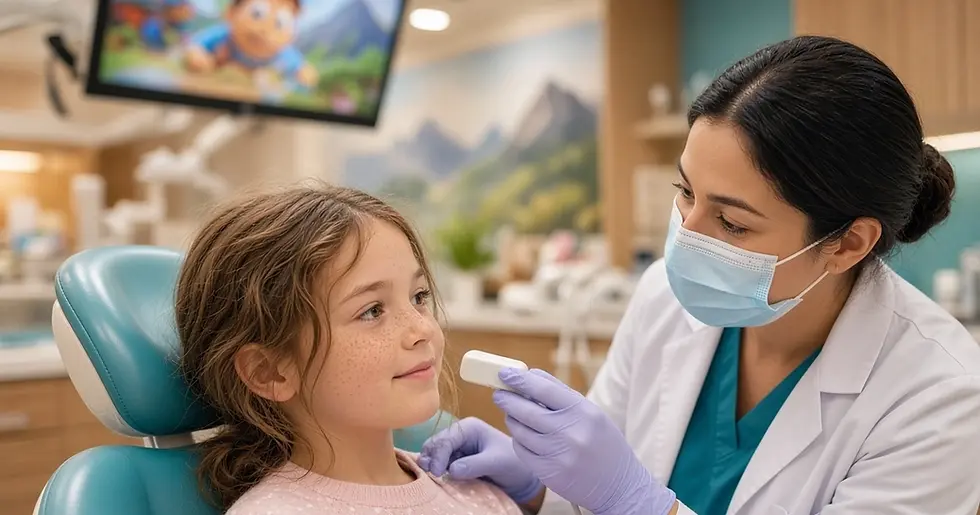
Our version hands kids control over small things. Each child picks the flavor of the cleaning paste and the flavor of the fluoride (there's a flavorless option, too). Then they pick a movie from a library of more than 70, which plays on TVs mounted to the ceiling above the chair. Instruments and X-ray sensors come in small sizes made for a child's mouth. Those choices are how we start with dental anxiety: a child who picked the movie and the flavor walks in with some control over a visit they didn't schedule.
X-rays happen in the treatment room, too. We use a camera-style digital X-ray unit, so your child stays in the chair and the movie doesn't have to stop.
Parents are welcome in the treatment room at every visit. The one exception is general anesthesia: once your child is asleep, you'll wait in the waiting room.
What are the sedation options for kids?
Pediatric sedation comes in levels, and the right level depends on the child and the work. We offer 3: nitrous oxide, moderate sedation, and deep sedation or general anesthesia given by an anesthesiologist.
It's easy to think of sedation as 2 choices: laughing gas or being put to sleep. That picture skips the middle level, and for some kids the middle level is all it takes. A child who can't get through a cleaning and X-rays awake can sometimes finish both with moderate sedation, which is given by mouth with no IV.
That fits the AAPD's behavior guidance guideline. It lists sedation for anxious kids when basic techniques haven't worked, and for kids who can't cooperate because they aren't emotionally mature enough yet or have a mental, physical, or medical condition. The table compares our 3 levels. For moderate sedation, deep sedation, and general anesthesia, the response column uses the definitions in the joint sedation guideline from the American Academy of Pediatrics and the AAPD.
Level | How it's given | How your child responds | Where it happens |
Nitrous oxide (laughing gas) | Breathed through a small nose mask | Awake and relaxed | Every treatment room (it's piped in) |
Moderate sedation | Oral medication | Responds on purpose to voices or a light touch | Our office |
Deep sedation or general anesthesia | Gas and an IV, given by an anesthesiologist | Deep sedation: hard to wake, responds on purpose only to repeated or painful stimulation. General anesthesia: can't be woken, even by pain | Our office, with an anesthesiologist from 1 of our 2 partner anesthesia practices |
Know this before you book: the anesthesiologists don't take insurance. The sedation options page names both partner practices and the medications we use for moderate sedation.

Adjusting the visit for kids with special needs
For kids with special needs, a pediatric dentist changes the room and the pace to fit the child, and keeps visits short enough that the child will come back.
Our special needs dental care starts with the room: private treatment rooms instead of an open bay, adjustable lighting, and sunglasses for kids who find the overhead light too bright. We book extra time so nobody is rushed. Every chair tilts. If a child won't lie back all the way, we do the cleaning and X-rays with the child partly sitting up.
Some kids start with a happy visit. The child comes in, looks around, and leaves without any treatment. Screens and flavors work as deliberate distraction, and every level of sedation is available when a child needs more help.
Dr. Grover's view is that kids with special needs can do more than adults expect, given enough explanation and patience. They often surprise their own parents. We keep the work itself short and end on a good note, because a good visit is what gets a child back in the chair 6 months later.
When should a baby first see a pediatric dentist?
When the first tooth comes in, and no later than the first birthday. The AAPD's checkup schedule puts the first exam at the first tooth and no later than 12 months. After that, exams repeat every 6 months, or on a schedule set by the child's risk. We book first visits by age 1 or within 6 months of the first tooth, whichever comes first, in line with the ADA.
Waiting has a cost. The ADA's pages for parents of babies and kids point out that cavities can start as soon as baby teeth appear.
At a baby's first visit, we use baby beds built for the job, which make a small mouth easier to see. Every baby exam includes a basic tongue-tie check. We also see newborns for tongue-tie evaluations before any teeth come in. The decision to release a tie rests on how it affects function, such as feeding, rather than age alone. When a release is needed, we use a soft tissue laser.
That first visit also gives your family what Children's Health in Dallas calls a dental home: one place to go with questions and emergencies.

Why do baby teeth need checkups every 6 months?
Decay can get through a baby tooth's enamel in under a year. A 6-month schedule gives us more chances to find it while it's still in the enamel.
A 2017 study in the Journal of Clinical Pediatric Dentistry tracked bitewing X-rays of 95 children ages 5 to 12. On average, decay took about 10 months to travel from the outer enamel to the dentin underneath. It took about 17 more months to reach the inner dentin, the layer closest to the nerve. The children came from low-income families, and the authors note that decay may move faster in that group, so other kids' timelines may differ.
With visits every 6 months, at least 1 checkup falls inside that 10-month stretch, and we take X-rays as often as your child's risk calls for. On a once-a-year schedule, a cavity can start and reach the dentin between visits. We'd rather find decay in the enamel, where fluoride or a white spots treatment can sometimes stop it. Once it's in the dentin, it usually needs a filling or a crown. Delta Dental's guide for parents of babies and toddlers describes the pediatric dentist's job as an ongoing assessment of a child's oral health. A 6-month rhythm is what keeps it ongoing.
Fluoride varnish is the other half of prevention. The CDC says varnish can prevent 33% of cavities in baby teeth. Our fluoride treatments go on at the end of the visit. The varnish sets as soon as it touches saliva, so your child can eat and drink on the drive home. Once the permanent back molars come in, sealants add more protection: according to the CDC, they can prevent up to 80% of cavities there for 2 years.
Fixing cavities in baby teeth: fillings, white crowns, and Hall crowns
Baby teeth get fillings and crowns sized for them. Baby molars also have an option built for them: a crown that goes on with no drilling and no numbing shot.
Small cavities get tooth-colored white fillings. Kids get laughing gas and pick a movie before we numb the tooth. Bigger damage on a baby molar usually means a crown, and we offer 2 kinds of dental crowns for kids.
White crowns look like natural teeth and work on front or back teeth. Ours come from Sprig and NuSmile. They need numbing, and we offer sedation for them.
Hall crowns are stainless steel, so they're silver. The trade-off is worth it for some kids: they go on with no drilling and no numbing, which suits a child who can't handle a needle or a long visit.
The technique has trial data behind it. A Scottish trial published in the Journal of Dental Research in 2011 put Hall crowns on 1 side of each child's mouth and standard restorations on the other. Over 5 years, 3% of the Hall crowns had a major failure, compared with 16.5% of the standard restorations. The AAPD still calls for more research comparing Hall crowns with traditionally placed steel crowns, so Hall crowns are 1 of our options, next to white crowns placed with numbing.
The bite matters, too, so we watch it as it develops. We offer Phase 1 orthodontics, usually between ages 6 and 10, for kids who need early correction.
Dental emergencies after hours
Current patients can reach the Mini Miners pediatric dentist on call for dental emergencies outside office hours: call (303) 500-3202 and press 2. During the day, we work to see patients of record the same business day.

Habits that start at home
Brush twice a day with fluoride toothpaste, floss daily once 2 teeth touch, and keep sugar away from bedtime.
For toothpaste, use no more than a smear, or a grain-of-rice amount, until age 3, then a pea-size amount from 3 to 6, per the ADA's healthy habits guidance. Colgate's guide to children's oral health calls teaching oral hygiene habits at a young age an investment that pays lifelong dividends.
Nemours KidsHealth has a page written for kids to read themselves. It tells them to brush for at least 2 minutes twice a day, and it explains why sugar right before bed can do the most damage. For printable help, HRSA, a federal health agency, offers free handouts on brushing a child's teeth and caring for a baby's mouth.
What does pediatric dental care cost without insurance?
At Mini Miners, a first visit for an uninsured child age 3 or under costs $75. Families without dental insurance can also join our membership plan.
The Mini Miners Membership costs $300 a year for a toddler, from the first tooth until age 3. For kids 4 and up, it's $420 a year, and siblings get lower rates. Both plans cover 2 cleanings and exams a year, 2 fluoride treatments, needed X-rays, 1 emergency exam, and up to 20% off other treatment (some exclusions apply). Prices are as of October 2026.
If you have coverage, the insurance plans we accept include Delta Dental, Cigna, MetLife, and Aetna PPO.
Who we see, and where to find us
We see kids starting as newborns and keep seeing them into young adulthood. There's no single age to switch to a general dentist. Our post on when to switch dentists covers how families decide.
Our team works at 61 Erie Pkwy, Unit 101, in the Erie Commons shopping area at the corner of Briggs St and Erie Pkwy, between I-25 and US-287. Parking is a surface lot with no meters. Families drive in from Lafayette, Louisville, Broomfield, Boulder, and Longmont. Outside the office, we visit local schools and daycares as part of our community work.
That's the role of pediatric dentistry as we practice it in Erie: specialist training, plus a visit built around the child in the chair. Call (303) 500-3202 or text (720) 734-5890 to book a first visit, or ask about a happy visit.
FAQs
At what age do children start losing their baby teeth?
Children typically begin losing their baby teeth around age six, though timing varies for each child. Pediatric dentists monitor this process to ensure permanent teeth emerge properly and address any concerns early.
Should my child use fluoride toothpaste?
Yes, children should use fluoride toothpaste to strengthen teeth and prevent cavities from forming. Use a rice-sized amount for children under three and a pea-sized amount for older kids.
What should I do if my child has a dental emergency?
Contact your pediatric dentist immediately if your child experiences a knocked-out tooth or severe pain. They have the expertise to handle emergencies and can provide guidance on immediate care steps.
How can I prevent cavities in my child's teeth?
Limit sugary foods and drinks, ensure proper brushing twice daily, and schedule regular dental checkups. Pediatric dentists also apply protective treatments like fluoride varnish and sealants to strengthen teeth further.
Is thumb sucking harmful to my child's teeth?
Prolonged thumb sucking beyond age four can affect tooth alignment and jaw development negatively. Pediatric dentists can provide strategies to help your child break this habit before it causes problems.


Excellent article that clearly explains the importance of pediatric dentistry and how early dental care helps children develop healthy habits for life. The focus on prevention, education, and creating positive dental experiences is especially valuable for parents. Families looking for a trusted Children Dentist in Houston can learn a lot from these helpful insights. Great work!