Sedation Dentistry For Special Needs Children In Erie, CO
Written By: Logan Grover, Health Content Writer |
Reviewed By: Dr. Alison Grover, Board-Certified Diplomate Pediatric Dentist |
Last Reviewed: August 27, 2026 |
Most articles about sedation dentistry for special needs children open by selling you on sedation. We start by trying to avoid it. At Mini Miners Pediatric Dentistry in Erie, Colorado, sedation is the last rung on a ladder that begins with a no-treatment "Happy Visit" and no-drill options like the Hall crown. Some children do need nitrous, oral sedation, or general anesthesia to get safe, complete care, and this guide walks through exactly when, why, and what each level involves. One note on who's writing this: Mini Miners was built by parents of a child with special needs, so it's the guide we wish someone had handed us.
Sedation dentistry for special needs children uses medication, from mild laughing gas to general anesthesia, to help a child with sensory, behavioral, developmental, or medical challenges get dental care safely and calmly. The right level depends on the child, the treatment needed, and the medical history. It is not a single rule applied to everyone.

When Is Sedation Dentistry for Special Needs Children Recommended?
Sedation is recommended when a child can't safely or comfortably get needed treatment by gentler means. It is a clinical decision, not an automatic one, and plenty of children with special needs never need more than a calm room and a patient team.
Five things shape the call: your child's age, their anxiety level, how much dental work is needed, their medical history, and how past healthcare visits have gone. A single small cavity in a cooperative eight-year-old is a different conversation than four cavities in a child who can't yet tolerate a mirror in the mouth. We talk all of it through with you first, because you're the expert on your child and we're the experts on the dentistry.
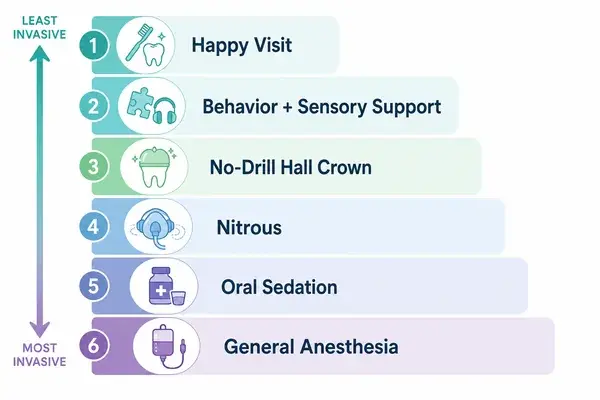
Start With the Least Invasive Option
Before any medication, we try the gentlest path that can still get the job done. This is where most of the field jumps straight to sedation and we don't.
It usually starts with a Happy Visit, where the only goal might be to walk in, sit in the chair, and leave. From there we add behavior guidance and sensory support: a private treatment room instead of an open bay, dimmer lighting, sunglasses, a comfort item from home, a movie on the ceiling, and breaks whenever your child needs one. For kids who are sensitive to sound, we can control the music and noise. For non-verbal children, we use picture cards, communication devices, or your read of their cues.
When there's a cavity, the tool matters as much as the calm. The Hall crown seals decay under a small metal cap with no drilling and no numbing shot, which means many kids who would need sedation for a traditional filling can skip it. Helping an anxious child feel safe at one visit also makes the next visit easier, so the gentle approach pays off twice.

The Three Levels of Sedation We Offer
When a child does need help relaxing, Mini Miners offers three levels of sedation, from lightest to deepest. Here's how they compare.
Level | How it's given | Is my child awake? | Best for | Recovery |
Nitrous oxide (mild) | Flavored gas mixed with oxygen through a small nose mask | Awake and responsive, a little drowsy and silly | Mild nerves, shorter procedures | Wears off in minutes; back to school or activities the same day |
Oral conscious sedation (moderate) | A liquid combination of Versed and hydroxyzine, taken by mouth | Conscious but drowsy, and usually won't remember the visit | Higher anxiety, longer visits, or kids not calmed by nitrous alone | Several hours; rest and adult supervision the rest of the day |
Deep sedation / general anesthesia | An anesthesiologist uses gas, then an IV, to bring your child fully asleep | Fully asleep and feels nothing | Extensive work, severe anxiety, or complex special needs | Several hours; rest and same-room adult supervision the rest of the day |
Nitrous is the one most kids meet first. They pick a flavor for the mask, breathe through the nose, and watch a movie. With oral sedation, many children simply have no memory of the appointment, which keeps the dentist from becoming a scary place. General anesthesia is the deepest option, used when the alternative is a frightened child and unfinished, needed care.
Is General Anesthesia Safe for Young Children?
For a healthy child getting one planned procedure, the risk from general anesthesia is low, and the more common risk is leaving real dental disease untreated. That said, parents deserve the honest picture.
In December 2016, the FDA warned that repeated or lengthy use of general anesthetic and sedation drugs, meaning more than three hours or multiple procedures, might affect brain development in children under three. Two facts sit next to that warning and rarely make it into these articles. First, the concern comes largely from animal studies, and the FDA has said there isn't enough human data to know how it translates to children. Second, the agency was clear that these procedures are often medically necessary, and the potential risk has to be weighed against the harm of not treating a child at all. A single, planned, shorter exposure is a very different thing than repeated long ones.
What this means in practice: if your child is under three and needs extensive work, it's a real conversation about timing and grouping treatment into one visit rather than several. We'd rather do that thinking with you out loud than pretend the question doesn't exist.

How We Keep Your Child Safe During Sedation
Safety comes from a second trained professional whose only job is watching your child. That's the standard the AAPD and the American Academy of Pediatrics set in their sedation guideline, most recently reaffirmed in June 2025: the person delivering deeper sedation should be a separate, skilled provider acting as an independent observer, not the same person doing the dental work.
That's exactly how our general anesthesia visits run. We partner with two local anesthesiology groups, Mile High Anesthesia and Rocky Mountain Dental Anesthesia, so a dedicated anesthesiologist checks your child's vitals before anything is given, places the IV once your child is asleep, and monitors breathing and heart rate for the entire procedure, all in the comfort of our Erie office. Before any sedation, we review your child's health history, current medications, and fasting instructions, because the pre-visit screen is where most problems are prevented.

What Sedation Costs, and How Insurance Works
The honest headline on cost: the dental work and the anesthesia are usually two separate bills, and families are often surprised by the second one. Here's how it breaks down at Mini Miners.
The dental treatment itself runs through most major dental insurance, including Aetna PPO, Anthem, Cigna, Delta Dental, MetLife, United Concordia, and United Healthcare. First visits for uninsured kids age three and under are $75, and families without insurance can use our membership plan. We take HSA and FSA cards and CareCredit, offer in-office payment plans for larger treatment, and give you a written estimate before we start.
The anesthesiologist for general anesthesia is billed separately, and those groups don't bill insurance directly. You pay them and can submit your own claim for possible reimbursement, so the smart move is to verify your medical and dental coverage in advance. No family should learn about that bill after the fact.
How Do I Prepare My Child for a Sedation Visit?
Good preparation is mostly about calm and clear instructions. We send you the specifics ahead of time, and following them closely keeps the day smooth.
For oral sedation and general anesthesia, there are fasting rules, meaning no food or drink for a set window before the visit, and we'll tell you exactly what and when. Dress your child in comfortable, loose clothing, bring a favorite comfort item, and keep your own tone light when you talk about the appointment, since kids read our nerves. A parent is welcome to stay, and for most children with special needs, having you in the room is the best comfort measure there is. After deeper sedation, plan a quiet day at home with an adult in the same room until the medicine fully wears off.
Questions to Ask Any Pediatric Dentist About Sedation
You can judge a lot about a practice from how it answers a few direct questions. Ask these of anyone, including us.
Who administers and monitors the sedation, and is there a separate anesthesia provider for deeper levels?
What training and emergency preparation does the team have?
What screening happens before sedation, and how is my child watched during and after?
Which level are you recommending, and what would we try first to avoid it?
How will I be billed, and is the anesthesia a separate charge?
A practice that welcomes those questions is one that has good answers. If you'd like ours, reach out to our Erie office any time.

The Goal Is a Child Who Can Get Dental Care for Life
Every step here points one direction: the least intervention that lets your child get healthy, complete care. Sometimes that's a Happy Visit and a Hall crown. Sometimes it's general anesthesia with an anesthesiologist at the monitor. Done well, sedation dentistry for special needs children turns the dentist from a place to survive into a place your child can handle for life. Start with a call, and we'll build the plan around your child.
FAQs
Is sedation dentistry safe for special needs children?
Yes, when it follows the AAPD and AAP sedation guideline reaffirmed in June 2025, which calls for a separate trained provider to monitor the child during deeper sedation. At Mini Miners, a dedicated anesthesiologist watches your child's vitals throughout general anesthesia while the dental team focuses on treatment.
Will my child be asleep during sedation?
Only under general anesthesia. With nitrous oxide your child stays awake and responsive, and with oral sedation they stay conscious but drowsy and usually won't remember the visit. Full sleep happens only at the deepest level.
Is general anesthesia safe for a child under 3?
For one planned, shorter procedure the risk is low. The FDA's 2016 warning applies to repeated or lengthy use, more than three hours, and is based largely on animal studies. The FDA also stressed weighing that against the harm of leaving real dental disease untreated, so timing and grouping care into one visit is worth discussing.
Can we avoid sedation altogether?
Often, yes. Many children do well with a Happy Visit, sensory accommodations, and no-drill options like the Hall crown, which treats a cavity without a shot or drilling. Sedation is the step we reach for when gentler tools can't get the needed care done safely.
Does insurance cover sedation dentistry for special needs children?
The dental treatment usually runs through major dental plans, and we give a written estimate first. The anesthesiologist's fee for general anesthesia is a separate bill that isn't billed to insurance directly, so verify your coverage in advance and plan to submit your own claim.
How do I prepare my child for a sedation visit?
Follow the fasting instructions we send, dress your child in comfortable clothes, and bring a favorite comfort item. Keep your tone calm, plan a quiet recovery day with an adult present, and know that a parent is welcome in the room.
How do I know which level of sedation my child needs?
It depends on your child's age, anxiety, medical history, and how much work is needed. Our team reviews all of it with you and recommends the lightest option that can safely get the treatment done, so you can make an informed choice.


Comments