How Pediatric Dentistry Supports Your Child's Overall Health
Updated: Oct 6
Tooth decay, which the Office of Head Start calls the most common childhood disease, is the main link between child oral health and overall health. The CDC says cavities in children can cause pain and may lead to problems with eating, speaking, playing, and learning. Infection from a cavity can also hurt the adult tooth growing underneath.
Pediatric dentists find and treat decay before it gets that far. They complete 2 to 3 years of specialty training after dental school and treat only children, according to the American Academy of Pediatric Dentistry (AAPD). The AAPD recommends a first exam when the first tooth comes in, and no later than age 1. At Mini Miners Pediatric Dentistry in Erie, Dr. Alison Grover is a board-certified Diplomate of the American Board of Pediatric Dentistry, and she completed her pediatric residency at UCLA. We cover the specialty itself in our post on what pediatric dentistry focuses on. This guide stays on how your child's teeth affect the rest of their health.
Here's how teeth connect to the rest of the body, with the source for each:
Area | What the evidence says | Source |
Eating | Children with dental pain can have trouble eating | Office of Head Start |
Speech | Dental pain can make it hard to speak clearly, and teeth help kids speak and chew | Office of Head Start; American Dental Association |
School | On average, 34 million school hours a year are lost to unplanned (emergency) dental care | CDC |
Adult teeth | Infection from a cavity can hurt the adult tooth growing underneath | CDC |
Long-term health | In adults, gum disease is tied to diabetes and may be a heart disease risk factor. Research shows a link, not proof of cause | National Institute of Dental and Craniofacial Research |
At checkups, we clean teeth, apply fluoride treatments and sealants, and track jaw growth and tooth eruption, so problems like cavities or a crossbite get caught while treatment is still simple. That matters because decay is common. The CDC's oral health tips for children note that more than 50% of kids ages 6 to 8 have had a cavity in at least one baby tooth.

How does child oral health affect overall health?
A child's oral health affects their overall health mainly through pain and infection. An untreated cavity can hurt, and once decay reaches the nerve, it can turn into a tooth abscess that needs same-day care. Swelling in the lip or cheek and a toothache with a fever are both signs of infection.
The damage can reach the next set of teeth, too, since the adult teeth that replace baby teeth form right underneath them. And pain costs school time: it's hard to focus on a spelling test with a throbbing molar.
Gums matter for the long run. In adults, research summarized by the National Institute of Dental and Craniofacial Research ties gum disease to diabetes and suggests it may be a heart disease risk factor. Those findings come from adults, and they show a link, not proof that one causes the other. But the brushing and flossing that keep gums healthy start in childhood.
Dr. Grover and I opened Mini Miners in 2017 with 4 patients. A checkup is where we look for decay and infection before your child feels any of it.
Can tooth pain change what a child eats?
Yes. A child with a sore tooth eats around the pain. The Office of Head Start's oral health resources put it plainly: "Children with dental pain can have trouble speaking clearly, eating, and learning." At the table, that often looks like crunchy fruit and raw vegetables getting pushed aside for softer, processed foods.
Few kids announce a toothache at dinner. Watch for these instead:
One-sided chewing
Refusing cold drinks or foods they used to like
Meals that suddenly take much longer
Night waking with jaw or face rubbing
Drinks matter too. Children's Health in Dallas warns that sippy cups can lead to decay and suggests using them only at meals, with water in a regular cup in between. At checkups, we also talk with families about snacks and drinks. Children with healthy teeth can eat a wider range of foods, including the crunchy fruits and vegetables that are hardest to chew around a sore tooth.

How dental care supports speech and growth
Teeth and the tongue work together to form sounds like "s" and "th," so a problem with either can show up in speech. The American Dental Association notes that teeth help kids speak, chew, and smile.
We see newborns for tongue tie evaluation, no first tooth required. When a release is needed, we use a soft tissue laser. Not every tongue tie causes speech problems, though. Many kids compensate on their own, so we check how the tongue moves as well as how it looks. We also offer airway evaluations alongside tongue tie checks.
What we watch as your child grows:
Tongue movement, starting in infancy
Bite and jaw growth at every checkup
Crossbites or crowding that may need early treatment
Baby teeth lost too early, since baby teeth hold the path adult teeth follow (AAPD)
We do orthodontic evaluation during regular checkups. When a child needs Phase 1 treatment, it usually happens between ages 6 and 10, while baby and adult teeth are mixed, and we do it in our office.

Building healthy habits that last a lifetime
Kids keep the habits they practice and the appointments they don't dread. The daily routine is short: Nemours KidsHealth tells kids to brush twice a day with fluoride toothpaste for at least 2 minutes and to floss once a day.
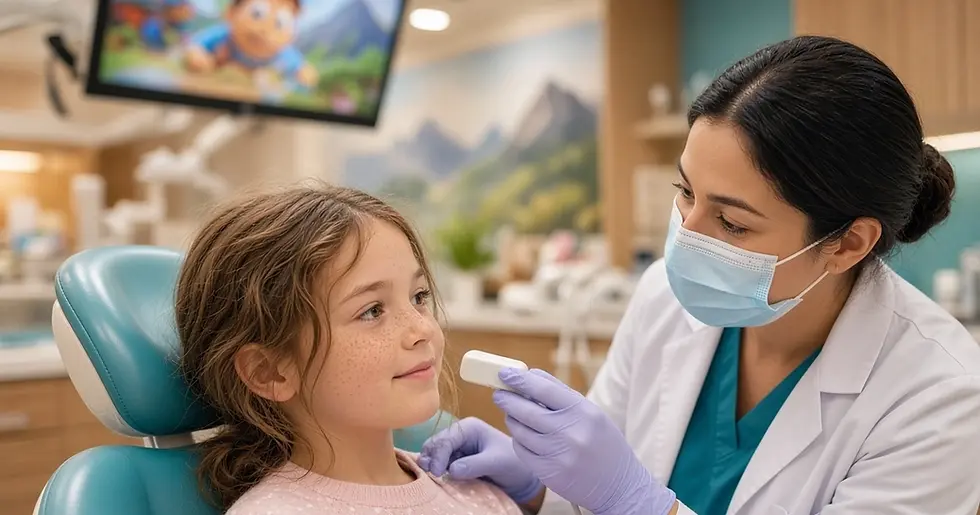
Every treatment room at Mini Miners has oral hygiene toys and displays we use to teach brushing during the visit. Your child also picks the flavor of the cleaning paste, the flavor of the fluoride, and a movie from a library of more than 70. Small choices give a child some control over an appointment they didn't ask for.
Our approach to dental anxiety management also skips scary words like "shot," "hurt," "needle," and "bleeding." Parents are always welcome in the treatment room. A visit that ends well makes the next one easier.
For home, the federal Health Resources and Services Administration (HRSA) offers printable oral health handouts, including a tip sheet on brushing a baby's teeth.

Why does my child need a checkup every 6 months?
The AAPD recommends an exam every 6 months, or on a different schedule if your child's cavity risk calls for it. We stick with 6 months for most kids because of how fast decay can move through baby teeth.
A 2017 study in the Journal of Clinical Pediatric Dentistry tracked cavities in the baby molars of 95 children, ages 5 to 12, on bitewing X-rays. The authors estimated that a cavity took about 0.8 years (roughly 10 months) to move from the outer enamel to the point where enamel meets the softer dentin underneath, and about 1.4 more years to reach the inner dentin. They also stressed that the timing varies a lot from child to child. The children came from a low-income clinic in Jerusalem, and the authors noted decay may move faster in that group than in children from higher-income families.
Our reasoning from those numbers: a 6-month visit gives us a good chance of catching a cavity while it's still in the enamel, where it's smaller and easier to treat. A full year between visits leaves more room for it to reach the dentin.
The CDC says fluoride varnish can prevent 33% of cavities in baby teeth. Sealants placed on molars soon after they come in can prevent up to 80% of cavities for 2 years and 50% for up to 4 years, according to the CDC. A Mini Miners checkup includes:
A cleaning with the paste flavor your child picks
Fluoride varnish that lets your child eat and drink normally right away. That's different from the American Academy of Pediatrics' general parent guidance on varnish, which calls for soft foods, nothing hot, and no brushing or flossing for at least 4 to 6 hours. Ask us at the visit about brushing that night. We also have flavorless fluoride for kids who don't like any flavor.
X-rays taken in the chair with a handheld unit that works like a camera, so the movie keeps playing. The sensors are sized for a child's mouth.
Sealants when your child's back teeth need them
A cavity risk check that sets how often your child should come back
A chalky white spot on a tooth can be early decay, or it can come from an injury or from enamel that formed weak. For white spots, we use ICON resin infiltration, which needs no drilling.
Boosting confidence and emotional health
Dental care protects confidence in 2 ways: repairs that look like natural teeth, and visits a child isn't afraid of. Children notice their teeth, and so do their classmates. A broken or dark front tooth can make a child hide their smile in photos.
We don't place silver (amalgam) fillings. Our white fillings are a tooth-colored mix of plastic and glass particles. For back teeth that need a crown, we offer white crowns, so nothing metal shows when your child laughs.
Emotional health at the dentist also means not dreading the next visit. We keep appointments short and end them on a good note on purpose, so a child is willing to come back.

When to start pediatric dental care
Start when the first tooth comes in, and no later than the first birthday. Delta Dental's tips for raising healthy toddlers put regular pediatric dentist visits on the same list as routine checkups, vaccinations, and car seats. That's how we'd frame it too. Dental visits belong on the same calendar as well-child checkups.
Our team also visits local schools and daycares to teach kids how to care for their teeth. Ask about our community outreach programs if your child's school or daycare wants a visit.
What happens at the first dental visit?
Your baby gets a short exam of the teeth and gums, including a tongue tie check, and you leave with a plan for home care. The ADA's MouthHealthy guidance puts that visit within 6 months after the first tooth appears. If the first birthday comes sooner, we see your baby then.
At the first visit, expect:
An exam of the teeth and gums, done on an infant exam bed
A tongue tie check
How to brush, plus fluoride and flossing basics
Time for your questions about pacifiers, thumb-sucking, or teething
Our care for babies page covers what to expect at that first exam and how to care for baby teeth at home. Babies who start early grow up treating the dentist as a normal place.
Age-appropriate dental milestones to watch for
Most babies get a first tooth around 6 months, have all 20 baby teeth by about age 3, and keep their back baby molars until about age 10 to 12. The American Society for the Positive Care of Children (American SPCC) gives the same starting point in its dental health guide: the first tooth usually breaks through around 6 months.
Milestone | Typical age |
First baby teeth come in (lower front) | 6 to 10 months |
Last baby molars come in | 23 to 33 months |
First adult molars come in, behind the baby teeth | 6 to 7 years |
Baby front teeth fall out | 6 to 8 years |
Baby molars fall out | 9 to 12 years |
Source: American Dental Association tooth development charts.
The back teeth are why "they're only baby teeth" doesn't hold up. A baby molar that gets a cavity at age 4 can stay in your child's mouth for another 5 to 8 years. The 2017 study above estimated that a cavity took about 2.2 years to go from the outer enamel to the inner dentin. By that math, a cavity left alone has time to cause pain or an abscess before the tooth falls out on its own.
When a baby molar is too damaged for a filling, dental crowns can protect it until it falls out naturally. We offer white crowns, and for some baby molars, Hall crowns: stainless steel crowns that go on with no drilling and no numbing shot. Some children get teeth early or late, which can call for a closer look. Our guide to when baby teeth fall out has the timeline tooth by tooth.
Signs your child needs immediate dental attention
Call right away for swelling in the lip, cheek, or mouth, a toothache with a fever, a knocked-out adult tooth, a broken tooth, bleeding that won't stop, or pain that keeps your child from eating or sleeping. If your child is a Mini Miners patient, call (303) 500-3202 and press 2 to reach our on-call pediatric dentist, including after hours. We work to get patients of record in the same business day.
Colgate's children's dental health tips give the same advice for injuries: see a dentist right away if a tooth is chipped, broken, or knocked out. Our emergency dental services page has the full first-aid steps. The first 10 minutes look like this:
Knocked-out adult tooth: pick it up by the crown (the white part), not the root. If it's dirty, rinse it briefly with water and try to put it back in the socket. If you can't, put it in a cup of milk and call us right away. Don't put a knocked-out baby tooth back in; the International Association of Dental Traumatology advises against it.
Chipped or broken tooth: rinse the mouth with warm water and hold a cold compress on the cheek.
Toothache: give an over-the-counter pain reliever made for children, dosed for their age and weight (not aspirin), and hold a cold compress on the cheek in 10-minute intervals.
Signs that need the ER first: trouble breathing or swallowing, drooling, swelling that spreads toward the eye or down the neck, or a swollen face with a fever in a child who seems sick. A dentist still has to treat the tooth afterward.
A tooth that turns dark after a fall can mean nerve damage, so call even if your child says it doesn't hurt.
Getting started at Mini Miners in Erie
Booking a checkup is the first step, and we plan the visit around your child. For children with special needs, every chair can stop partway up, so a child who won't lie flat can still get a cleaning and X-rays sitting up. Happy visits let a child see the office and meet the team with no treatment at all. Dr. Grover has a lot of personal experience with special needs children. Her approach starts from the view that these kids can do more than adults expect when they get enough explanation and patience.
When a child needs more help, our sedation options come in 3 levels: mild (nitrous oxide, or laughing gas), which is plumbed into every treatment room; moderate (oral conscious sedation, a liquid mix of 2 medications); and deep (general anesthesia, given in our office by an anesthesiologist). For some kids, moderate sedation is enough to get through a cleaning and X-rays. Each level has its own prep instructions, which we go over before the visit.
Our billing and insurance team works with most major dental insurance providers and offers the Mini Miners Membership Plan for families without dental coverage. We also take HSA and FSA cards and CareCredit, and we offer in-office payment plans.
Call (303) 500-3202 or text (720) 734-5890 to book a checkup at our office at 61 Erie Pkwy, Unit 101, in Erie Commons. A visit every 6 months keeps watch on your child's oral health and overall health, and it's how small problems stay small.
FAQs
When should my child have their first dental appointment?
Schedule your child's first dental visit by their first birthday or when their first tooth appears. Early appointments establish a dental home and allow the dentist to monitor development from the start.
How often does my child need dental checkups?
Most children should visit the dentist every six months for routine checkups and cleanings. Your pediatric dentist may recommend more frequent visits if your child has specific dental concerns.
What makes pediatric dentists different from regular dentists?
Pediatric dentists receive additional training specifically focused on children's dental development and behavior management techniques. They create child-friendly environments that reduce anxiety and make dental visits positive experiences for young patients.
Are baby teeth really that important if they fall out anyway?
Baby teeth are crucial because they hold space for permanent teeth and support proper speech development. They also enable children to eat nutritious foods and contribute to healthy jaw and facial development.
How can I help my child feel less anxious about dental visits?
Talk positively about dental appointments and avoid using scary words that create unnecessary fear. Read children's books about visiting the dentist and consider scheduling a preliminary visit to familiarize them.


Comments