How Pacifiers And Thumb Sucking Affect Your Child's Teeth In 2026
Updated: 5 days ago
Pacifiers and thumb sucking reshape a child's bite when the habit runs long enough. Steady pressure on growing bone can open a gap between the front teeth, pull the upper back teeth inside the lower ones, or push the top front teeth forward. Stop before age 3 and an open bite tied to pacifier use usually improves without treatment. Keep going past 36 months and the odds turn against you.
One thing most parenting articles get backward: how hard your child sucks matters less than how many hours a day the pacifier is in. The American Academy of Pediatric Dentistry's guideline on the developing dentition says the duration of force is more important than its magnitude. Hours beat intensity.
Pacifier teeth is the everyday name for bite changes caused by non-nutritive sucking, meaning sucking that gives comfort rather than food. The 3 changes pediatric dentists see most are anterior open bite, posterior crossbite, and increased overjet. The American Academy of Pediatric Dentistry links all 3 to pacifier or finger habits that continue past 18 months.
This is not a rare problem. A national poll from C.S. Mott Children's Hospital, fielded in February 2025 with 820 parents of children age 1 to 6, found 51% report their child currently uses or previously used a pacifier, and 23% report a thumb or finger habit. Of those parents, 9% felt they acted too late on the pacifier and 16% felt they acted too late on thumb sucking.
Dr. Alison Grover has been treating Erie kids since opening Mini Miners in 2017, and the pattern repeats: parents assume the habit will fade on its own. Often it does. The families who end up in orthodontic treatment are usually the ones who waited past 3 to find out.
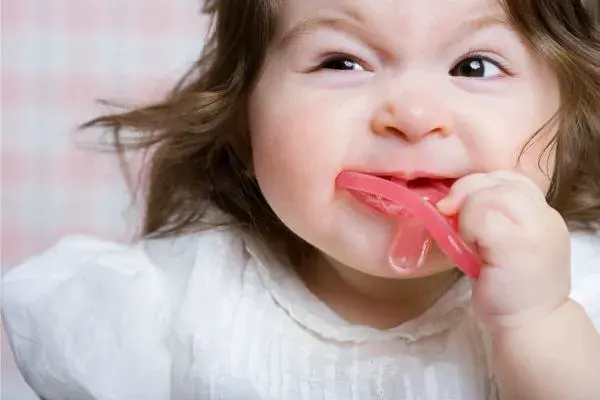
What Happens to A Child’s Teeth During Pacifier Use?
Constant pressure against the teeth, gums, and roof of the mouth slowly reshapes bone. Baby teeth shift, the palate narrows, and the jaw develops around the habit instead of around normal muscle balance.
This starts earlier than most parents expect. The AAPD's 2024 pacifier policy states that use beyond 18 months can influence the developing orofacial complex, and recommends discontinuing or limiting pacifier use when the canines emerge at roughly 18 months. Not at 3. At 18 months.
The AAPD guideline's point about duration is the one that should change what you do tonight. A child who sucks hard for 20 minutes at bedtime is applying force for 20 minutes. A child who keeps a pacifier in through naps, car rides, and the grocery store is applying gentler force for 6 or 8 hours. The second child is the one whose bite changes. So the useful question is not how forceful the habit looks, it's how many hours of the day the pacifier is in the mouth. Count them for 2 days. Most parents are surprised by the number.
The 3 bite problems that show up most
Anterior open bite
An open bite means the top and bottom front teeth don't meet when the mouth closes, leaving a visible gap. It makes biting into a sandwich harder and can affect how certain sounds are formed.
A 2026 systematic review and meta-analysis in Dentistry Journal put numbers on it. Compared with children who have no habit, digit sucking carried an odds ratio of 5.0 for anterior open bite and pacifier sucking carried an odds ratio of 7.39, both at p < 0.001. Head to head, the difference between the 2 habits was not statistically meaningful for open bite (OR 1.77, p = 0.150). Both habits do this. Neither is the safe one.
Posterior crossbite
A crossbite means the upper back teeth sit inside the lower back teeth instead of outside them. Left alone, the jaw learns to shift sideways to chew, and that shift can pull growth off center.
This is where the 2 habits split. In that same 2026 review, pacifier sucking carried an odds ratio of 2.80 for posterior crossbite against children with no habit, at p < 0.001. Digit sucking came in at 1.27 and did not reach statistical significance (p = 0.055). Compared directly against each other, pacifiers carried 2.66 times the crossbite odds of thumb sucking. For this one specific problem, the pacifier is the worse habit.
Protruding front teeth
Forward pressure pushes the upper front teeth out. The AAPD's pacifier policy notes that increased overjet and Class II malocclusion are more strongly associated with a finger habit than a pacifier habit, which is the reverse of the crossbite finding.
There's a practical risk parents rarely hear about. Front teeth that stick out get hit. A playground fall that a normal bite absorbs can chip or knock out a protruding incisor, and children with a large overjet often can't close their lips over those teeth, which leads to mouth breathing and a dry mouth. If that happens to a Mini Miners patient, call (303) 500-3202 and press 2. That reaches the Mini Miners pediatric dentist on call, including outside office hours, and patients of record are worked in the same business day. Our emergency care for kids page has the first-10-minutes steps for a knocked-out tooth. Save the number before you need it.

Thumb Sucking vs. Pacifiers: Which Does More Damage?
They cause different problems, and the 2026 review is more specific than most articles let on.
Pacifiers dominate crossbite risk. Thumbs dominate overjet and Class II. Open bite belongs to both. So there is no version of "at least it's only a thumb" or "at least it's only a pacifier" that survives the data.
The practical difference is control. You can take a pacifier away. You cannot take a thumb away, and the AAPD policy notes that children who used a pacifier were less likely to develop a finger-sucking habit at all. That is a point in the pacifier's favor, with a catch covered in the next section.
When should you take the pacifier away?
Start weaning at 18 months and be finished by 36 months. Those are the 2 numbers in the AAPD's pacifier policy, and they are not interchangeable.
Eighteen months is when the canines come in and the AAPD advises discontinuing or limiting use. Thirty-six months is the deadline: the policy states that children using a pacifier 36 months or longer had a higher rate of anterior open bite, and that an anterior open bite associated with pacifier use will improve after elimination of the pacifier before age 3. The policy also says the transverse occlusal relationship, the crossbite question, should be evaluated before age 3.
Treat 3 as the line, not 4 and not 5. Every month past it costs you self-correction odds.
Why pulling the pacifier too fast can backfire
Cold turkey has a documented failure mode. The AAPD's pacifier policy states that forced early cessation of pacifier use has been associated with prolonged finger sucking.
Read that again, because it inverts the standard advice. Throw the pacifiers away in a single dramatic evening and you may trade a habit you controlled for a habit you can't reach, in a child who now has a thumb available 24 hours a day. Given the 2026 odds ratios, swapping a pacifier for a thumb trades a crossbite risk for an overjet risk. It is not a win.
Taper instead. Cut the hours before you cut the habit: daytime first, car rides next, then naps, then bedtime last. You are lowering total duration, which is the thing the AAPD guideline says matters most, and you are giving the child time to find another way to settle.

Do "orthodontic" pacifiers protect the bite?
The evidence does not support paying extra for one. Manufacturers market flattened "orthodontic" nipples as gentler on the palate, and the finite-element research from 2025 does not back the marketing.
A 2025 biomechanical analysis in Applied Sciences modeled 6 pacifier designs against a 1-month-old palate. Anatomical designs distributed stress a little more evenly, but the authors reported that maximum equivalent stress values were almost within a limited range with no significant variations between designs. A separate 2025 finite-element study in Head & Face Medicine compared 4 commercial pacifiers and published no percentage advantage for any design category, noting that in vivo validation is still needed.
The AAPD's own read is the same. One systematic review found orthodontic pacifiers induce less open bite than conventional ones, but 2 other reviews concluded the evidence was insufficient to support a preference for orthodontic pacifiers in preventing malocclusion.
Parents routinely spend $15 to $20 a pair on specialty pacifiers believing the shape solves the problem. Duration is the variable that moves the outcome. An orthodontic pacifier still in use at 30 months is a bigger problem than a plain round one that stopped at 14 months.
How to break the habit at home
Most children stop between ages 2 and 4 without help. If yours hasn't, these are the approaches that work, in the order we suggest trying them.
Taper the hours first, as above. Some parents cut the tip of the pacifier so the suction fails and the child loses interest; use scissors rather than teeth, and check daily for pieces small enough to swallow. For thumbs, bitter-tasting polish made for the purpose costs a few dollars, and loosely wrapping the thumb at night interrupts the sleep-time habit that most children can't control on purpose. Sticker charts and small rewards beat punishment, because a habit that has become a stress response gets worse when stress goes up.
When home methods stall, ask your pediatric dentist about a habit appliance, a small device fixed behind the upper front teeth that makes sucking unsatisfying. It typically takes 3 to 6 months.
For an anxious child, we'd rather start with a happy visit. The child comes in, sees the treatment room, meets the team, picks a movie, and leaves with no treatment done. We do those here with a pediatric specialist instead of sending you elsewhere, and for a fearful child one of them does more than any appliance. If dental fear is already part of the picture, our page on dental anxiety in children covers the rest of the approach.

What it costs to fix pacifier teeth
Almost nobody asks this at the 18-month checkup, and it is the number that should drive the decision. The gap between acting at 2 and acting at 8 runs into thousands of dollars.
Habit cessation before age 3 | $0 (self-corrects) | Weeks to months |
Habit appliance (ages 4-8) | $500-$2,500 | 3-6 months |
Phase I early braces (ages 6-10) | $2,000-$4,000 | 12-18 months |
Full metal braces | $3,000-$7,500 | 18-24 months |
Ceramic or clear braces | $4,000-$8,500 | 18-24 months |
Clear aligners + myofunctional therapy | $7,000-$13,000 | 12-36 months |
Those are general US market ranges, not Mini Miners fees.
What we can tell you about our side of it: we quote the number before treatment starts and we don't add charges after the appointment. We take all major private insurance, and for families without dental coverage the Mini Miners Membership Plan keeps the cost of routine visits predictable. Details on coverage and payment are on our billing and insurance page. If the bite has already moved far enough to need correcting, our orthodontics for kids page explains what Phase I involves.
Stopping the habit before 3 is the only line in that table that costs nothing.
Will the Damage Reverse on Its Own?
Sometimes, and timing decides it. The AAPD's pacifier policy states that an anterior open bite associated with pacifier use will improve after elimination of the pacifier before age 3.
Most articles stop there. They shouldn't. The AAPD's guideline on the developing dentition also notes that some evidence indicates changes resulting from sucking habits persist past cessation of the habit. Both statements come from the same academy, and they pull in opposite directions. Stopping before 3 gives you the best odds of self-correction. It is not a guarantee, and a bite that has been under 8 hours of daily pressure for 2 years does not always spring back.
The 2026 review is consistent with that: habits continuing past 3 to 4 years raise the risk of malocclusion that sticks.
So the plan splits by age. Before 3, your job is to stop the habit and let growth do the work. After 4, the bone has adapted and a pediatric dentist or orthodontist needs to be involved. Between 3 and 4, get it looked at now rather than at the next cleaning.
Mini Miners Pediatric Dentistry is at 61 Erie Pkwy, Unit 101, in Erie Commons at the corner of Briggs St and Erie Pkwy, between I-25 and US-287, with parking directly outside and under 5 minutes from most local schools. Families drive in from Lafayette, Louisville, Broomfield, Boulder, Longmont, Westminster, Thornton, Brighton, Arvada, Johnstown, and Berthoud. To get a bite check on the calendar, book an appointment or call (303) 500-3202.
FAQs
Does thumb sucking cause permanent buck teeth?
It can if the habit is forceful and continues past age 4. A 2026 meta-analysis found that prolonged thumb sucking raises open bite risk by 5 to 8 times compared to children without the habit. If your child stops before age 3, protruding teeth often shift back on their own as the jaw continues to grow.
Is a pacifier worse than thumb sucking for my child's teeth?
They cause different problems. Pacifiers carry a higher risk of posterior crossbite (OR = 2.66 per a 2026 study), while thumb sucking is more strongly linked to overjet and Class II malocclusion. Pacifiers are easier to take away, which is why the AAPD recommends them over thumb sucking if your child needs a sucking habit.
At what age should I take away my child's pacifier?
Start weaning at 18 months. The AAPD's revised 2024 policy identifies 18 months as the point where orofacial development starts being affected. The hard deadline is 36 months. After that, the chance of self-correction drops sharply.
Will my child's open bite fix itself after they stop using a pacifier?
Usually yes if they stop before age 3. The jaw is still growing at that point, and bite changes from pacifier use often reverse without treatment. After age 4, self-correction is rare and orthodontic intervention is typically needed, with costs ranging from $2,000 to $7,500 depending on severity.
Do orthodontic pacifiers prevent dental problems?
Not if used long enough. A 2025 study found orthodontic pacifiers reduce palatal pressure by 75-95% compared to conventional pacifiers. But the AAPD still calls the evidence "insufficient" to recommend them over regular pacifiers. Duration of use matters more than the shape of the nipple.
How much does it cost to fix pacifier teeth?
It depends on when you act. Stopping the habit before age 3 costs nothing because the bite self-corrects. A habit appliance for ages 4-8 runs $500-$2,500. Full orthodontic braces later can cost $3,000-$7,500 for metal or up to $13,000 for clear aligners with myofunctional therapy. Most dental insurance covers 25-50% for kids under 18.
When should my child first see a pediatric dentist about pacifier use?
By their first birthday. The AAPD recommends establishing a dental home by age 1. At that visit, your pediatric dentist will evaluate whether your child's sucking habits are affecting development and create a plan for weaning if needed. Early detection at 12-18 months can prevent problems that cost thousands to correct later.


Comments