


Cavity Prevention In Arvada, CO
Stop cavities before they start. Board-certified pediatric dentist Dr. Alison Grover builds a prevention plan around your child's real risk, not a template.
The best cavity treatment is the one your child never needs. Cavity prevention means stopping tooth decay before it forms, using sealants, professional fluoride, and a plan matched to your child's diet, teeth, and habits. Most Arvada families reach our Erie office in about half an hour, and most preventive visits are covered by insurance.
What What cavity prevention actually is
Cavity prevention is proactive care that keeps decay from ever starting. It pairs in-office protection, cleanings, fluoride varnish, and sealants with a home routine and diet plan built for your specific child. Every plan at Mini Miners starts with a caries risk assessment, so we target the things raising your child's risk instead of guessing.
Tooth decay is the most common chronic disease of childhood, according to the CDC. It is also one of the most preventable, which is the whole point of getting ahead of it.

Our cavity prevention approach
Every plan is built around your child's risk, not a checklist. Here is what protection looks like in practice:
Professional cleanings
Every six months, we remove the plaque and tartar a toothbrush leaves behind and get a clear look at any early decay.
Digital X-rays
Low-radiation images that catch decay hiding between teeth. We take them right in the room with a camera-style scanner, so your child keeps watching their movie.
Diet and habit coaching
Specific, family-friendly guidance on the drinks and snacks that drive decay, and the easy swaps that don't.
Fluoride varnish
Strengthens enamel and can reverse early decay before it becomes a cavity. It cuts decay in baby teeth by about 37% (CDC). Ours lets kids eat and drink right after, with no waiting.
Dental sealants
A thin coating over the grooves of the back teeth, where most childhood cavities start. Sealants prevent about 80% of cavities on those surfaces (CDC).
Is your child at higher risk for cavities?
Some kids get a cavity no matter how well they brush; others coast on good genes. A caries risk assessment tells us which one you have, so the plan fits your child.
Risk climbs with any of these:
Bottles or sippy cups of milk, juice, or formula at bedtime
Frequent snacking, or sugary and acidic drinks through the day
Deep grooves in the molars, or enamel that didn't form fully
A parent or sibling with a history of cavities
Special health care needs, or medications that dry the mouth
Little or no fluoride exposure
Colorado built a whole program around catching this early. The state's Cavity Free at Three initiative trains pediatricians and family doctors, not only dentists, to assess risk and apply fluoride varnish during regular well-child visits. Kids who get four or more varnish applications by age three have lower rates of early childhood cavities.
Healthy habits at home
Prevention between visits comes down to four habits.
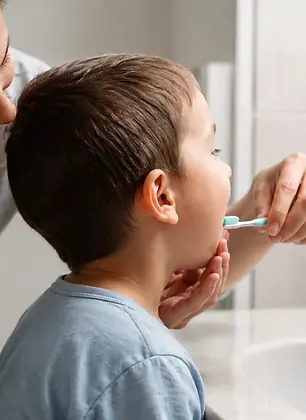
Brush twice a day with fluoride toothpaste, a rice-grain smear under age 3, a pea-sized amount after. Help them until about age 7 or 8, when they can do it well on their own.
Floss once any two teeth touch. Kid flossers make it faster and less of a fight.
Watch frequency, not just amount. Sipping juice or grazing on starchy snacks all day is worse than the same treat in one sitting. Water is the best between-meal drink; it rinses food and keeps saliva flowing.
Keep the six-month checkups. A cavity takes about six months to form on a baby tooth, so twice-a-year visits catch problems while they are still reversible.
Why Arvada families drive to Mini Miners
Dr. Alison Grover is a board-certified pediatric dentist (Diplomate) who completed her pediatric dental residency at UCLA and holds a degree in child psychology from Wellesley. She is also a parent. That combination shows up in how the office runs:
Over 70 movies, plus flavor menus for cleaning paste and fluoride, so kids customize the visit
Small instruments and sensors sized for small mouths
All levels of sedation, from nitrous (plumbed into every room) to deep sedation, for anxious kids and larger treatments
A "no scary words" policy, a prize tower after every visit, and a waiting area with an arcade and a slide
Parents welcome in the room for every appointment

FAQs
At what age should my child first see a dentist?
By age one, or within six months of the first tooth coming in, whichever is first. We also see newborns for tongue-tie evaluation.
Are dental sealants and fluoride safe for children?
Yes. Sealants and fluoride are recommended by the CDC and the American Academy of Pediatric Dentistry. Sealants prevent about 80% of cavities on the back teeth, and fluoride varnish cuts decay in baby teeth by about 37%. Both are quick, painless, and applied in small, child-appropriate amounts.
Why treat baby teeth if they're just going to fall out?
Baby teeth hold space for the permanent teeth and guide them into place. Losing one early to decay can crowd the adult teeth and lead to orthodontic work later. Decay also causes real pain and infection while the tooth is still there.
How often should my child come in?
Every six months. A cavity takes about six months to form on a baby tooth, so twice-a-year visits catch problems early, while they are still reversible.
Do you see kids with dental anxiety or special health care needs?
Yes. We offer all levels of sedation, use small instruments, explain everything before we do it, and welcome parents in the room. Dr. Grover has extensive experience with special needs children.
Start your child's cavity-free journey
New patients from Arvada and the north metro are always welcome. Book a first visit and we'll build your child a prevention plan from day one.


Monday 8 AM–5 PM
Tuesday 8 AM–5 PM
Wednesday 8 AM-5 PM
Thursday 8 AM–5 PM
Friday 8 AM–3:30 PM
Saturday Closed
Sunday Closed

Copyright © 2025 Mini Miners Pediatric Dentistry. All rights reserved.
Mini Miners Pediatric Dentistry
61 Erie Pkwy, Unit 101
Erie, CO 80516
Phone: (303) 500-3202
Text: (720) 734-5890
Email: MiniMinersPD@gmail.com
Fax: (303) 552-3700